
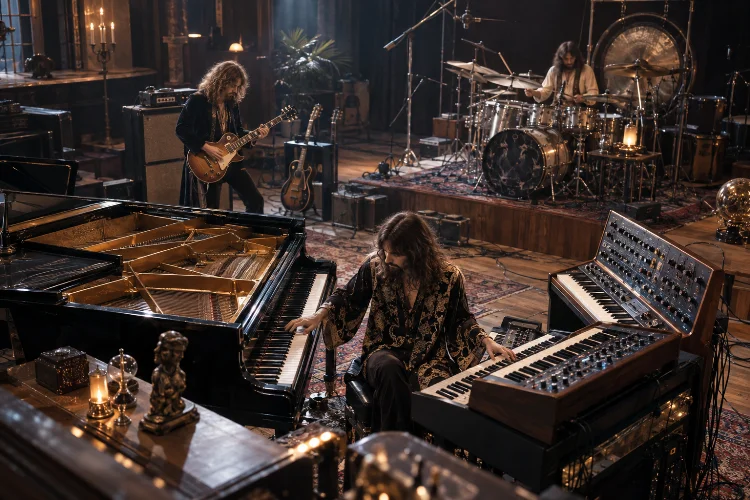
Imagine listening to a rock song that begins with a gentle piano melody, suddenly shifts into an unusual rhythm, introduces a classical-inspired keyboard passage, and eventually explodes into a dramatic guitar solo.
Just when you think you’ve figured out where the music is heading, everything changes again.
Welcome to the fascinating world of progressive rock.
During the 1970s, musicians began challenging the traditional boundaries of popular music.
Instead of relying entirely on simple chord progressions, predictable song structures, and short radio-friendly compositions, ambitious bands explored longer arrangements, unconventional rhythms, and sophisticated instrumental performances.
The result was a musical movement that transformed expectations about what rock music could accomplish.
Understanding how progressive rock redefined musical complexity in the 1970s means exploring more than complicated guitar solos or lengthy compositions.
It’s about discovering how musicians combined classical traditions, jazz improvisation, innovative technology, and imaginative storytelling to create entirely new listening experiences.
Bands such as Yes, Genesis, King Crimson, Pink Floyd, and Emerson, Lake & Palmer became pioneers of this creative revolution.
Their influence continues shaping modern music.
So, what made this era so revolutionary, and why does its musical experimentation still matter today?
Let’s explore.
1. The Origins of Progressive Rock in the Early 1970s
Before progressive rock became a major musical movement, popular rock songs generally followed relatively familiar structures.
Many successful recordings featured straightforward verses, memorable choruses, and instrumental sections designed to support the main melody.
However, the late 1960s introduced an increasingly experimental atmosphere.
From Psychedelic Rock to Musical Exploration
Artists began exploring unusual studio effects, extended improvisations, and unconventional instrumentation.
The Beatles’ Sgt. Pepper’s Lonely Hearts Club Band, released in 1967, helped demonstrate how ambitious production and album-wide artistic ideas could expand popular music.
Meanwhile, psychedelic groups experimented with extended compositions and sound effects that challenged traditional expectations.
These developments encouraged younger musicians to explore more sophisticated arrangements.
King Crimson’s 1969 debut, In the Court of the Crimson King, became particularly influential.
Its combination of heavy guitar riffs, Mellotron textures, jazz-inspired passages, and dramatic compositions established an important foundation for the emerging genre.
Tracks such as “21st Century Schizoid Man” demonstrated how aggressive rock could coexist with intricate musical structures.
Why Musicians Wanted Something Different
By the beginning of the 1970s, many rock musicians were interested in expanding their artistic vocabulary.
Some had studied classical music, while others admired jazz improvisation or experimental electronic composition.
They wanted to explore musical possibilities that extended beyond conventional pop songwriting.
The growing popularity of album-oriented listening also created opportunities for more ambitious recordings.
Instead of producing only short singles, artists could develop extended compositions intended for attentive home listening.
This environment helped progressive music flourish throughout the decade.
2. Complex Time Signatures and Revolutionary Rhythmic Structures
One of the most recognizable characteristics of progressive rock is its unusual approach to rhythm.
Traditional rock music commonly uses a 4/4 time signature, meaning each measure contains four quarter-note beats.
There’s nothing wrong with this structure, of course.
However, progressive musicians frequently explored alternatives that created unexpected rhythmic patterns.
Understanding Odd Time Signatures
Time signatures such as 5/4, 7/4, and 7/8 became important elements of the genre’s musical vocabulary.
These rhythms can initially feel unfamiliar because they organize beats differently from conventional rock.
For example, a 7/8 pattern might divide its seven eighth notes into groups of three, two, and two.
Instead of counting four evenly spaced beats, musicians emphasize a repeating pattern with an uneven structure.
This creates rhythmic tension while still allowing the music to maintain a recognizable groove.
Pink Floyd’s “Money,” from The Dark Side of the Moon, offers a famous example.
Its main bass riff uses a 7/4 meter, producing an immediately distinctive rhythmic feel.
During the guitar solo, the song moves into a more conventional 4/4 section.
This change provides an effective contrast between unusual and familiar rhythmic structures.
How Rhythm Became Part of Musical Storytelling
Bands such as Yes, Genesis, and Rush frequently used changing meters to develop musical ideas.
Instead of maintaining one rhythm throughout an entire composition, they shifted between different patterns.
A section might begin with a relatively simple groove before introducing faster subdivisions or unexpected accents.
These transitions created momentum without necessarily increasing the tempo.
Rush drummer Neil Peart became especially admired for combining technical precision with imaginative rhythmic arrangements.
His playing demonstrated that complicated drumming could remain energetic and emotionally engaging.
The real innovation wasn’t simply using unusual numbers.
It was creating rhythms that supported the musical atmosphere.
For modern musicians, practicing unfamiliar time signatures remains an excellent way to improve coordination and develop fresh songwriting ideas.
3. Combining Classical Music, Jazz, and Rock Instrumentation
Progressive musicians rarely limited themselves to one musical tradition.
They borrowed ideas from classical composition, jazz improvisation, folk music, and experimental electronic sounds.
This willingness to combine influences helped create the genre’s unmistakable identity.
Classical Music Influences on Rock Composition
Classical music provided an important source of inspiration for many progressive bands.
Musicians explored extended musical forms, recurring themes, counterpoint, and sophisticated harmonic movement.
Counterpoint involves combining multiple independent melodic lines into a coordinated musical arrangement.
Rather than simply playing chords underneath a lead melody, different instruments can contribute individual musical ideas.
Yes frequently demonstrated this approach.
Guitarist Steve Howe, bassist Chris Squire, and keyboardist Rick Wakeman developed instrumental arrangements where several parts interacted in intricate ways.
Their music often sounded orchestral despite being performed by a relatively small rock ensemble.
Emerson, Lake & Palmer took classical influences even further.
Their 1971 live album Pictures at an Exhibition reinterpreted music originally composed by Modest Mussorgsky.
Keyboardist Keith Emerson used rock instrumentation to transform classical material into a dramatic performance.
These recordings demonstrated that musical traditions could be combined without losing their distinctive characteristics.
Jazz Improvisation and Instrumental Freedom
Jazz also contributed significantly to the genre’s development.
Many progressive musicians admired jazz’s harmonic sophistication, instrumental experimentation, and emphasis on improvisation.
King Crimson frequently explored this relationship.
Their music incorporated unconventional rhythms, dissonant textures, and instrumental passages that moved beyond familiar blues-rock patterns.
Bands could alternate carefully composed sections with more spontaneous performances.
This balance between structure and freedom created exciting musical possibilities.
Rather than treating complexity as an isolated technical challenge, musicians used it to develop conversations between instruments.
These interactions helped make progressive rock sound unpredicatble and adventurous.
4. Epic Compositions and the Rise of Concept Albums
Another revolutionary development involved the length and structure of rock compositions.
While commercial singles often lasted approximately three or four minutes, progressive bands regularly created pieces extending beyond ten or twenty minutes.
Some compositions occupied an entire side of a vinyl record.
Why Longer Songs Changed Rock Songwriting
Extended compositions allowed musicians to develop musical themes gradually.
Instead of repeating a verse and chorus several times, they could introduce contrasting sections, elaborate instrumental transitions, and recurring melodies.
Yes provided one of the most celebrated examples with “Close to the Edge.”
Released in 1972, the approximately 18-minute composition occupied the entire first side of the album bearing its name.
The piece moves through several contrasting musical environments, including energetic instrumental passages, atmospheric sections, and powerful climaxes.
Its structure encourages listeners to experience the recording as a continuous musical journey.
Genesis explored similar possibilities with “Supper’s Ready,” from their 1972 album Foxtrot.
Running for roughly 23 minutes, the composition combines theatrical storytelling, changing musical textures, and recurring ideas.
These lengthy arrangements demonstrated that rock could support dramatic structures resembling larger classical works.
How Concept Albums Became Artistic Statements
Concept albums existed before the 1970s, but progressive musicians helped make them central to the genre.
Instead of presenting unrelated songs, a conceptual record might explore one overarching theme or narrative.
Pink Floyd’s The Dark Side of the Moon, released in 1973, investigates subjects including time, money, mortality, and psychological pressure.
Its interconnected tracks, recurring sounds, and atmospheric transitions create a cohesive listening experience.
Jethro Tull took a different approach with Thick as a Brick in 1972.
The album consists of a continuous composition divided across the two sides of its original vinyl release.
Interestingly, frontman Ian Anderson intended the project partly as a humorous response to the increasingly serious concept-album trend.
Rush explored science-fiction storytelling through the side-long title suite of 2112, released in 1976.
These recordings expanded the possibilities of album craftsmanship.
They encouraged listeners to engage with complete musical works rather than focusing exclusively on individual songs.
5. Synthesizers and Recording Technology Expanded Musical Possibilities
The 1970s also witnessed important developments in electronic instruments and recording technology.
Progressive musicians enthusiastically explored these tools to develop sounds that conventional rock instruments couldn’t easily reproduce.
Keyboards became particularly important.
The Mellotron and Moog Synthesizer
The Mellotron was one of the genre’s most recognizable instruments.
It used prerecorded tape sounds triggered by a keyboard, allowing musicians to reproduce textures resembling strings, flutes, and choirs.
Bands such as King Crimson and Genesis used the instrument to create dramatic, orchestral-like atmospheres.
Its distinctive character contributed to the dreamlike quality of many early progressive recordings.
The Moog synthesizer offered different possibilities.
Rather than reproducing prerecorded acoustic sounds, it generated electronic tones that musicians could manipulate using oscillators, filters, and other controls.
Keith Emerson became especially famous for incorporating Moog synthesizers into his performances.
Rick Wakeman also helped establish keyboards as prominent lead instruments within rock music.
These innovations transformed the role of the keyboardist.
Instead of merely accompanying guitar-driven arrangements, keyboard players could develop powerful melodies and dramatic instrumental solos.
Multitrack Recording and Experimental Production
Recording studios also became important creative environments.
Multitrack technology allowed musicians to record separate instrumental performances and combine them into more elaborate arrangements.
Producers and engineers could experiment with layered sounds, stereo movement, tape effects, and unusual recording techniques.
Pink Floyd became especially influential in this area.
During the sessions for The Dark Side of the Moon at Abbey Road Studios, the band explored sound effects, electronic textures, and carefully constructed transitions.
The recording features clocks, spoken voices, cash-register sounds, and synthesizer sequences.
These elements contribute to the album’s thematic atmosphere rather than functioning as random decoration.
This approach demonstrated how studio production could become an essential part of musical composition.
The technological experimantation of the era helped establish foundations for later electronic, ambient, and experimental rock music.
6. The Progressive Rock Bands That Defined Musical Complexity
Although progressive rock shared certain characteristics, its leading bands developed remarkably different identities.
Some emphasized instrumental virtuosity, while others focused on theatrical storytelling, atmospheric production, or conceptual songwriting.
Understanding these differences reveals the movement’s creative diversity.
Yes: Instrumental Precision and Expansive Arrangements
Yes became one of the genre’s defining bands through intricate instrumental interactions and elaborate compositions.
Albums such as Fragile and Close to the Edge featured sophisticated arrangements, distinctive vocal harmonies, and ambitious structures.
Chris Squire’s melodic bass playing became an especially recognizable part of the band’s sound.
Rather than functioning exclusively as a supporting instrument, his bass frequently introduced independent musical ideas.
Steve Howe’s guitar work combined classical influences, rock techniques, and acoustic textures.
Together, these elements created compositions that rewarded repeated listening.
Genesis: Theatrical Storytelling and Emotional Complexity
Genesis developed a different approach during the Peter Gabriel era.
Albums such as Foxtrot and Selling England by the Pound combined imaginative narratives with intricate musical arrangements.
Gabriel’s theatrical performances and elaborate costumes added a visual dimension to the band’s storytelling.
Meanwhile, Tony Banks contributed sophisticated keyboard arrangements, and Steve Hackett developed distinctive guitar textures.
The band’s music frequently moved between gentle acoustic sections and powerful instrumental passages.
This combination demonstrated that musical complexity could support storytelling without overwhelming its emotional content.
Emerson, Lake & Palmer: Classical Ambition and Virtuosity
Emerson, Lake & Palmer became famous for combining classical influences with extraordinary instrumental skill.
Their 1971 album Tarkus featured an approximately 21-minute title suite divided into several sections.
Keith Emerson’s keyboard performances explored rapid passages, unusual harmonies, and dramatic electronic sounds.
Carl Palmer’s energetic drumming provided rhythmic sophistication, while Greg Lake contributed bass, guitar, and vocals.
The trio helped establish keyboard-driven rock as a major component of the progressive movement.
Pink Floyd: Atmospheric Complexity and Emotional Depth
Pink Floyd demonstrated that sophisticated rock music didn’t always require constant instrumental virtuosity.
Their compositions frequently emphasized atmosphere, sound design, and emotional progression.
Albums such as The Dark Side of the Moon, Wish You Were Here, and Animals explored philosophical and social themes through carefully structured recordings.
David Gilmour’s expressive guitar playing often favored melodic phrasing over technical speed.
Richard Wright’s keyboard textures helped create expansive musical environments.
This approach showed that complexity could emerge through arrangement, production, and thematic development.
7. The Lasting Influence of 1970s Progressive Rock
By the late 1970s, the musical landscape was changing.
Punk rock emerged partly as a reaction against what some listeners considered the excessive complexity and theatrical presentation of established rock bands.
Shorter songs, direct arrangements, and raw energy became increasingly attractive.
However, progressive music didn’t simply disappear.
From Progressive Rock to Progressive Metal
During the following decades, musicians continued exploring unconventional rhythms, lengthy compositions, and advanced instrumental techniques.
Bands such as Dream Theater and Queensrÿche combined progressive structures with heavy metal instrumentation.
Later artists, including Porcupine Tree, Tool, Opeth, and The Mars Volta, developed distinctive approaches informed by earlier experimentation.
These musicians didn’t merely reproduce the sounds of the 1970s.
They adapted earlier ideas to modern production techniques and different musical environments.
The influence also extended into experimental electronic music, post-rock, and contemporary instrumental composition.
What Modern Musicians Can Learn
You don’t need advanced music theory knowledge to appreciate or learn from progressive rock.
Start by listening carefully to how individual compositions develop over time.
Pay attention to transitions between quiet and energetic sections, changes in rhythm, and recurring melodic ideas.
Try writing a simple musical phrase and experimenting with different arrangements.
You could change its time signature, introduce contrasting instrumentation, or develop a second melody that interacts with the original.
Another useful exercise involves exploring unfamiliar musical influences.
Listen to jazz, classical music, folk traditions, or electronic compositions and consider how their techniques might influence your own songwriting.
The most valuable lesson isn’t that every song should contain complicated rhythms or extended instrumental solos.
It’s that creative possibilities expand when musicians remain curious.
Progressive rock proved that technical ability becomes most meaningful when it supports emotional expression and imaginative musical ideas.
Progressive rock transformed the musical landscape of the 1970s by challenging traditional songwriting structures and embracing ambitious artistic experimentation.
Through unusual time signatures, extended compositions, classical influences, jazz-inspired improvisation, and innovative recording technology, musicians expanded expectations about what rock music could become.
Bands such as Yes, Genesis, King Crimson, Pink Floyd, and Emerson, Lake & Palmer demonstrated that complexity could coexist with memorable melodies and emotional storytelling.
Their influence continues shaping progressive metal, experimental rock, and modern music production.
Most importantly, the movement encouraged artists to explore beyond familiar creative boundaries.
Want to experience this musical revolution firsthand? Listen to Close to the Edge, Foxtrot, Tarkus, and The Dark Side of the Moon.
Explore their arrangements, follow their changing rhythms, and discover how adventurous musical ideas can transform an ordinary listening experience into something extraordinary.