
Ever wondered why a Led Zeppelin guitar riff can sound so powerful even when Jimmy Page is playing just a handful of notes?
Listen to the opening of “Whole Lotta Love,” the mysterious atmosphere of “Kashmir,” or the unforgettable solo in “Stairway to Heaven.” Each performance feels completely different, yet they all carry the unmistakable personality of one guitarist.
That’s the magic of Jimmy Page.
While many legendary players became famous for incredible speed or technical perfection, Page approached the electric guitar differently.
He combined raw blues emotion, creative songwriting, unusual tunings, dramatic effects, and innovative recording methods to develop a sound that helped redefine rock music.
The most fascinating thing about Jimmy Page guitar techniques is that they aren’t necessarily complicated. Sometimes, the secret is a perfectly placed note, a slightly unexpected rhythm, or knowing when to let the guitar breathe.
In this guide, we’ll explore the playing styles, creative tricks, and production ideas that shaped Led Zeppelin’s legendary sound – and discover what modern guitarists can learn from them.
1. Powerful Guitar Riffs That Became Rock Anthems
Turning Simple Musical Ideas Into Massive Riffs
One of Jimmy Page’s greatest talents was transforming relatively simple guitar phrases into unforgettable musical statements.
Take “Whole Lotta Love,” released on Led Zeppelin II in 1969. Its instantly recognizable riff relies on a compact musical idea, but the combination of timing, distortion, and confident execution makes it sound enormous.
Page understood that a memorable riff doesn’t need dozens of notes. It needs a strong identity, an interesting groove, and enough space for the rhythm section to make everything feel bigger.
You can hear a similar philosophy in “Heartbreaker,” where aggressive single-note phrases combine with a driving rock arrangement. The riff feels dangerous because of its sharp attack, blues-based movement, and relentless energy.
Rhythmic Displacement and Unexpected Accents
Another signature element of Page’s playing is his willingness to make a riff feel slightly unpredictable.
“Black Dog” is a perfect example. Although bassist John Paul Jones originally composed its main riff, Page helped turn that challenging musical pattern into a powerful guitar-driven arrangement.
The song uses a clever call-and-response structure, with Robert Plant’s vocals alternating with bursts of instrumental energy. The riff’s unusual phrasing creates rhythmic tension even though the underlying groove remains grounded.
“Kashmir” takes this concept further by combining repeating guitar figures with a powerful rhythmic foundation. The shifting relationship between the guitar pattern and the beat creates a hypnotic, almost orchestral sensation.
For guitarists, the lesson is straightforward: experiment with accents, pauses, and unexpected phrase lengths instead of always starting every riff on the strongest beat.
A little rythm variation can make an ordinary musical idea feel surprisingly original.
2. Blues Guitar Techniques With Raw Emotion
Expressive String Bending and Vibrato
Before Led Zeppelin became a global phenomenon, Page had already developed a deep appreciation for American blues guitar.
Players such as B.B. King, Freddie King, and other blues pioneers helped establish the expressive vocabulary that influenced generations of British rock musicians.
Page absorbed that tradition but adapted it to his own musical personality. Rather than copying blues phrases mechanically, he transformed them through aggressive articulation, sustained notes, and dramatic changes in intensity.
Listen closely to “Since I’ve Been Loving You” from Led Zeppelin III. The performance is packed with emotional bends, expressive vibrato, and phrases that seem to respond directly to Plant’s vocals.
One important technique is controlled string bending. Instead of simply pushing a string upward, Page often shapes the pitch gradually, allowing the note to build emotional tension before resolving.
His vibrato can also sound wide and urgent, giving sustained notes a distinctly vocal quality.
Minor Pentatonic Scales and Improvised Solos
Much of Page’s blues-rock vocabulary draws from minor pentatonic scales, occasionally expanded with blues notes, major-scale colors, and chromatic passing tones.
These scales are common in rock music, but Page’s phrasing makes them interesting.
The famous unaccompanied solo section in “Heartbreaker” demonstrates his spontaneous approach. Rapid runs, bends, pull-offs, and irregular phrasing create an exciting performance that sounds more like an emotional outburst than a carefully polished exercise.
Interestingly, some of Page’s most memorable moments contain rough edges. His playing can feel loose, but that looseness contributes to the energy of the performance.
Modern guitarists sometimes spend countless hours trying to make every note mathematically perfect. Page’s work suggests that emotion, timing, and musical direction matter just as much.
Try playing a simple five-note pentatonic phrase and repeating it with different bends, pauses, and picking attacks. You’ll quickly discover how many emotions can come from the same notes.
3. Acoustic Fingerpicking and the Art of Light and Shade
Why Acoustic Guitar Was Essential to Led Zeppelin
Although Page is often associated with distorted electric guitars and explosive solos, acoustic playing was equally important to his musical identity.
He drew inspiration from traditional folk, British acoustic guitarists, and Celtic-influenced music. Artists such as Bert Jansch and Davey Graham helped demonstrate how fingerpicking and alternative tunings could create rich musical textures.
You can hear these influences throughout Led Zeppelin’s catalog, particularly in songs that move between delicate acoustic passages and heavy electric arrangements.
“Babe I’m Gonna Leave You” is a remarkable example of this contrast. Gentle acoustic arpeggios gradually give way to dramatic full-band sections, making the louder moments feel even more intense.
Instead of maintaining the same energy throughout the song, Page uses dynamics to create a musical journey.
This approach became one of Led Zeppelin’s most recognizable characteristics: the interaction between softness and power.
Fingerstyle Patterns and Flowing Arpeggios
The introduction to “Stairway to Heaven” reveals another important side of Page’s musicianship.
Its carefully arranged acoustic notes create a delicate atmosphere long before the song develops into a full-scale rock performance. Each chord contributes to the melody rather than functioning as simple background accompaniment.
Page frequently used fingerpicking patterns that combined moving bass notes with ringing upper strings. This approach allows a single guitar to suggest several musical layers simultaneously.
“Going to California” showcases an equally beautiful acoustic style, with flowing patterns and open-string resonance supporting a more intimate arrangement.
For beginners, these techniques are excellent exercises in finger independence.
Start by assigning your thumb to the bass strings while your index, middle, and ring fingers handle the higher strings. Practice slowly until the bass movement and upper melody feel naturally connected.
The real goal isn’t speed. It’s producing a smooth, balanced sound where every note has a purpose.
4. Alternate Guitar Tunings That Created New Sonic Possibilities
DADGAD Tuning and the Sound of “Kashmir”
One of the most fascinating Jimmy Page guitar techniques is his extensive use of alternate tunings.
Most guitarists spend years working in standard tuning, E-A-D-G-B-E. Page frequently changed the relationship between the strings to discover chord voicings and melodic patterns that would be difficult to create otherwise.
Perhaps his most famous alternative is DADGAD tuning.
In this configuration, the strings are tuned from lowest to highest as D-A-D-G-A-D. The resulting open-string combination creates a suspended, harmonically ambiguous sound.
“Kashmir,” released on Physical Graffiti in 1975, demonstrates the extraordinary possibilities of this tuning.
Page combines ringing open strings with moving fretted notes, producing enormous chord textures without relying on conventional rock chord shapes.
The result feels mysterious, dramatic, and almost cinematic.
DADGAD also appears in “Black Mountain Side,” where acoustic fingerpicking and drone-like strings create a strong connection to folk traditions.
Open Tunings and Unusual Chord Voicings
Page’s exploration went far beyond DADGAD.
“The Rain Song” uses the unusual D-G-C-G-C-D tuning, helping create its dreamy, sophisticated harmonic character. The altered string relationships allow chords to flow into one another with beautiful resonance.
Open G tuning, typically D-G-D-G-B-D, appears in songs such as “That’s the Way,” offering another set of possibilities for acoustic and electric guitar.
Meanwhile, “In My Time of Dying” makes extensive use of slide guitar in an open A configuration.
Why do these tunings matter so much?
Because changing the tuning changes the physical possibilities of the instrument. Familiar finger movements suddenly produce unfamiliar chords, encouraging musicians to write differently.
Try tuning your guitar to DADGAD and strumming all six strings. Then move a simple two-finger shape up the fretboard while allowing the open strings to ring.
You’ll hear how seemingly basic movements can produce surprisingly rich harmonies.
Just remember to retune carefully and use an accurate tuner when exploring unfamiliar configurations.
5. Slide Guitar, Violin Bow, and Experimental Sound Effects
Slide Guitar for Expressive, Singing Notes
Jimmy Page never treated the guitar as an instrument limited to conventional fretting and picking.
Slide guitar allowed him to create smooth pitch transitions, vocal-like melodies, and expressive blues phrases. Instead of producing clearly separated notes, a slide lets the performer glide continuously between pitches.
“In My Time of Dying” offers one of the strongest examples of Page’s slide playing.
The track combines traditional blues influences with heavy amplification, dramatic phrasing, and an intense full-band performance.
His approach emphasizes tone and emotional delivery rather than technical complexity alone.
Slide playing also requires careful control. The performer generally places the slide directly above the fret rather than pressing the string against the fretboard, while muting unwanted string noise.
That combination helps produce clear, sustained notes with a distinctive character.
Playing Electric Guitar With a Violin Bow
Few stage techniques are more closely associated with Page than his use of a violin bow on electric guitar.
During performances of “Dazed and Confused,” he would draw a bow across the strings, producing eerie sustained tones that sounded radically different from traditional electric guitar playing.
He had experimented with the approach during his earlier career, before making it a memorable part of Led Zeppelin’s performances.
The technique works particularly well with amplification and reverberation, which extend the notes and emphasize their unusual harmonic textures.
Rather than playing a conventional solo, Page could create an atmosphere filled with tension and strange sonic movement.
The performance sometimes resembled a piece of experiemntal classical music more than a typical rock guitar feature.
The Theremin and Psychedelic Guitar Textures
The middle section of “Whole Lotta Love” demonstrates another aspect of Page’s willingness to explore unconventional sounds.
Alongside heavily processed guitar noises, he used a theremin, an electronic instrument that produces tones without requiring physical contact.
By moving his hands around the instrument’s antennas, Page could manipulate pitch and volume to create ghostly, science-fiction-like effects.
He also radically detuned his guitar and pulled on the strings to generate deep, growling sounds.
These elements helped transform a blues-based rock track into a psychedelic sonic adventure.
For modern musicians, the bigger lesson is to explore sound itself – not just scales, chords, and recognizable melodies.
6. Guitar Tone, Amplifiers, and Effects That Shaped the Sound
From Fender Telecaster to Gibson Les Paul
Jimmy Page’s legendary guitar tone wasn’t built around one instrument or one amplifier.
During Led Zeppelin’s earliest recordings, he relied heavily on a Fender Telecaster, producing cutting, articulate sounds that suited both aggressive riffs and expressive lead playing.
The first Led Zeppelin album prominently featured his Telecaster paired with a Supro amplifier and selected effects.
As the band’s sound developed, Page increasingly embraced the Gibson Les Paul.
Its humbucker pickups, strong sustain, and thick tonal response helped create the powerful guitar character associated with recordings such as “Whole Lotta Love” and “Heartbreaker.”
Onstage, his Les Paul and Marshall amplifier combination became one of classic rock’s defining visual and sonic partnerships.
However, Page continued choosing instruments according to the demands of individual songs.
The legendary “Stairway to Heaven” solo, for example, was recorded using a Fender Telecaster rather than his more famous Les Paul.
Wah-Wah, Distortion, and Dynamic Control
Page used effects creatively, but his sound was never simply the result of stacking pedals.
A Sola Sound Tone Bender helped him explore fuzz-driven sustain, while a wah-wah pedal introduced expressive tonal movement. Tape echo and other studio treatments added depth and atmosphere.
However, the guitarist’s hands remained essential to the final result.
Picking intensity, string attack, vibrato, and volume adjustments could dramatically change the character of a passage.
This is particularly important when trying to recreate his tone today.
A modern guitarist doesn’t necessarily need vintage equipment worth thousands of dollars. A responsive electric guitar, a moderately driven amplifier, and careful attention to playing dynamics can capture much of the same musical spirit.
Try using less distortion than you initially expect. Then increase your picking intensity and adjust your guitar’s volume control to move between cleaner and more aggressive sounds.
That interaction between technique and equipment is a major part of Page’s tonal identity.
7. Guitar Layering and Studio Production Innovations
Creating the Legendary “Guitar Army”
Jimmy Page wasn’t only Led Zeppelin’s guitarist. He was also the band’s producer and a highly experienced former session musician.
That background gave him an unusually sophisticated understanding of how guitar parts could interact inside a recording.
Rather than simply recording one rhythm guitar and adding a solo, he frequently built arrangements using multiple complementary guitar lines.
“Stairway to Heaven” demonstrates this method beautifully.
Acoustic guitar, electric 12-string textures, and carefully placed lead parts gradually expand the arrangement as the song moves toward its climax.
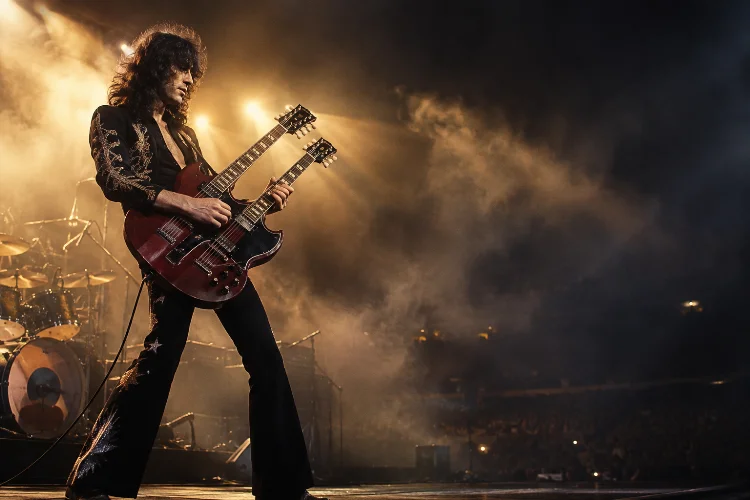
Onstage, Page famously used a Gibson EDS-1275 double-neck guitar to reproduce the contrasting six-string and 12-string parts without switching instruments.
The layering became even more ambitious on “Ten Years Gone” and “Achilles Last Stand.”
In these recordings, overlapping guitar melodies and harmonized parts create a dense musical landscape that resembles an orchestra constructed from electric guitars.
The interesting detail is that the individual parts often remain relatively straightforward.
Their combined effect is what makes the arrangement extraordinary.
Backward Echo and Creative Recording Experiments
Page was also fascinated by techniques that changed the perceived movement of recorded sounds.
One especially innovative method was backward echo, sometimes called reverse echo.
The basic idea involves reversing recorded audio, applying echo or reverberation, and reversing it again so the effect appears to swell before the original sound.
Page had explored this approach during his time with the Yardbirds and later brought it into Led Zeppelin’s recordings.
“You Shook Me,” from the band’s debut album, contains an early example of his creative use of this technique.
The effect adds an unsettling atmosphere that conventional guitar playing alone could never produce.
Page also approached microphone placement as a creative tool. Instead of always placing microphones extremely close to instruments, he appreciated how room acoustics and distance could add depth.
This philosophy helped establish the spacious, powerful character associated with many Led Zeppelin recordings.
What Modern Guitarists Can Learn From His Production Style
Today’s digital recording software makes these experiments far easier than they were during the analog tape era.
You can record a simple rhythm guitar, add a second part with a different voicing, and place the tracks in separate areas of the stereo field.
Try adding a third guitar that plays only occasional melodic responses rather than doubling everything.
Next, experiment with subtile delay, room reverb, or reversed audio to introduce atmosphere.
The key is making each layer contribute something meaningful.
Page understood that a massive guitar sound doesn’t always come from recording louder instruments. Sometimes, it comes from arranging different sounds intelligently.
That principle remains useful whether you’re recording in an expensive professional studio or working with a laptop in your bedroom.
8. Why Jimmy Page’s Guitar Style Still Matters Today
Decades after Led Zeppelin’s most influential recordings, Page’s approach continues to inspire rock, blues, alternative, and heavy metal guitarists.
His musical legacy is larger than a collection of famous riffs. It includes a philosophy built around experimentation, emotional expression, and the freedom to combine different musical traditions.
One moment, his playing can sound gentle and acoustic. The next, it becomes thunderous, distorted, and almost unpredicatable.
That contrast helped establish a blueprint for countless bands that followed.
It also reminds modern guitarists that technique should serve the song.
A fast solo might be impressive, but a carefully placed bend can be equally memorable. An unusual tuning might inspire a completely new composition, while a simple recording experiment can transform an ordinary guitar part.
Instead of focusing exclusively on copying Page’s exact equipment or finger positions, study how he creates tension and release.
Listen to the interaction between guitar and drums, notice when arrangements become quieter, and pay attention to how different tones support the emotional direction of a song.
Ultimately, the most valuable thing to borrow from Jimmy Page isn’t a particular riff.
It’s his willingness to explore possibilities that other players might overlook.
Jimmy Page helped shape Led Zeppelin’s unmistakable sound by combining powerful riffs, expressive blues phrasing, acoustic fingerpicking, alternate tunings, and adventurous recording techniques.
His greatest achievement wasn’t simply playing extraordinary guitar solos. It was understanding how tone, rhythm, dynamics, and arrangement could work together to create unforgettable music.
From the massive energy of “Whole Lotta Love” to the intricate beauty of “Stairway to Heaven,” his performances demonstrate that creativity matters just as much as technical ability.
If you’re a guitarist, start experimenting with one of these ideas today. Explore a new tuning, record layered guitar parts, or give a familiar blues phrase a different emotional character.
And next time you listen to Led Zeppelin, pay closer attention to the details behind the sound. You might discover an entirely new appreciation for Jimmy Page’s musical genius.