
Imagine putting on an album and realizing, halfway through, that you’re not simply listening to individual songs.
You’re experiencing an entire journey filled with strange sounds, emotional performances, philosophical questions, and musical transitions that seem to connect everything together.
That’s exactly what Pink Floyd achieved with The Dark Side of the Moon.
Released in March 1973, this legendary recording transformed how audiences and musicians understood the possibilities of a rock album.
Instead of treating each track as a completely separate composition, Pink Floyd constructed a carefully connected musical experience exploring time, money, mortality, conflict, and the pressures of everyday life.
But the album’s remarkable success wasn’t just about its songwriting.
Its creative production techniques, experimental sound design, innovative recording methods, and seamless arrangements helped establish a new standard for ambitious studio albums.
The fascinating part? Much of that sophisticated sound was created using analog equipment that seems incredibly limited compared with today’s digital recording technology.
So, how did The Dark Side of the Moon redefine concept album production, and why do modern music producers still admire its approach?
Let’s explore the creative decisions and groundbreaking techniques behind one of rock music’s most influential recordings.
1. How Pink Floyd Transformed the Concept Album Format
Concept Albums Existed Before Pink Floyd
It’s important to understand that Pink Floyd didn’t invent the concept album.
Artists had already experimented with recordings built around connected ideas and narratives. The Beatles’ Sgt. Pepper’s Lonely Hearts Club Band, The Who’s Tommy, and Marvin Gaye’s What’s Going On demonstrated different ways of creating larger musical statements.
However, The Dark Side of the Moon approached the format with an especially strong emphasis on sonic continuity.
Instead of relying entirely on lyrics or a fictional storyline, Pink Floyd used recording techniques to make the entire album feel connected.
Musical themes reappeared, environmental sounds linked different tracks, and carefully arranged transitions helped listeners move naturally between contrasting moods.
The result felt less like a traditional collection of songs and more like one extended composition.
Developing the Album Through Live Performances
Another interesting aspect of its creation was the band’s unusual development process.
Pink Floyd began performing an early version of the material in January 1972, months before the finished studio album appeared.
These concerts allowed Roger Waters, David Gilmour, Richard Wright, and Nick Mason to experiment with arrangements and discover which musical ideas worked best.
Rather than entering the studio with completely untested compositions, they had already spent considerable time developing the material.
This gave the album a strong musical foundation before the more elaborate production work began.
For modern producers, the lesson is surprisingly practical: sophisticated recording technology becomes much more effective when the underlying compositions are already compelling.
A great concept needs more than interesting effects. It needs music capable of supporting the overall idea.
2. Building a Unified Story Through Music and Sound
Exploring the Pressures of Human Life
One of the album’s greatest achievements is its ability to explore complex subjects without following a conventional plot.
Roger Waters developed lyrics around experiences and pressures that almost everyone understands, including anxiety, ambition, aging, greed, death, and psychological distress.
Each song approaches a different part of that larger theme.
“Breathe” introduces the pressures of living and working, while “On the Run” creates a restless feeling associated with travel and anxiety.
“Time” addresses the uncomfortable realization that life is passing quickly, and “The Great Gig in the Sky” confronts mortality through an almost entirely wordless performance.
The second half continues with “Money,” “Us and Them,” and “Brain Damage,” eventually reaching the philosophical conclusion of “Eclipse.”
What makes these tracks powerful is how naturally their subjects connect.
You don’t need a detailed explanation of the lyrics to understand the overall emotional journey.
Using Musical Repetition to Strengthen the Narrative
Pink Floyd also employed recurring musical and sonic ideas to reinforce the album’s unity.
The opening track, “Speak to Me,” introduces several sounds that appear later, functioning almost like a preview of the experience ahead.
A heartbeat-like pulse establishes an intimate, human atmosphere before the music develops into something much larger.
That pulse also returns near the album’s ending.
This creates a circular structure, suggesting that the experiences explored throughout the recording belong to an ongoing human cycle.
It’s a subtle storytelling technique, but an effective one.
Modern concept albums frequently use recurring melodies, sound effects, or vocal fragments to connect their songs. Pink Floyd’s achievement demonstrated how these elements could give a recording a unified identity without making every track sound identical.
3. Abbey Road Studios and the Revolution in Multitrack Recording
The Technology Behind the Legendary Sound
Much of The Dark Side of the Moon was recorded at EMI Studios in London, now known as Abbey Road Studios.
According to Abbey Road’s historical records, the sessions took place between May 30, 1972, and February 9, 1973.
The band worked with engineer Alan Parsons, whose technical expertise was especially valuable for such an ambitious project.
Pink Floyd received the album’s production credit, while Chris Thomas contributed to the final mixing process as mixing supervisor.
Together, the musicians and recording professionals developed a remarkably detailed sound using analog studio technology.
A particularly important advancement was the availability of 16-track tape recording.
This allowed different instruments, vocals, and effects to be recorded on separate tracks, providing additional flexibility when building complex arrangements.
Today, a digital audio workstation can handle hundreds of audio tracks.
Back then, sixteen tracks represented valuable creative space that had to be managed carefully.
Making the Most of Limited Recording Equipment
Because the group frequently needed more tracks, engineers sometimes combined several recordings into a smaller number of tracks through a process called bouncing.
For example, multiple drum or instrumental tracks could be mixed together and recorded onto another tape machine.
This created room for additional overdubs, but it also meant certain mixing decisions became permanent.
Unlike modern digital recording, there wasn’t an unlimited undo function.
Every major decision required attention.
The band also used tape-based delays, analog equalization, compression, and plate reverberation to create depth and atmosphere.
These techniques weren’t invented specifically for the album, but their integration was exceptionally ambitious.
The real innovation came from treating the recording studio as a creative instrument rather than simply a place to document a live performance.
And that’s one of the biggest reasons the album still sounds so distinctive.
4. Tape Loops and Sound Effects Became Part of the Music
The Ingenious Cash Register Sequence in “Money”
One of the clearest examples of Pink Floyd’s production creativity appears at the beginning of “Money.”
Instead of opening with a conventional instrumental introduction, the song features a repeating sequence of cash registers, coins, mechanical sounds, and tearing paper.
These sounds were recorded and physically edited into a tape loop.
The sequence follows a seven-beat pattern that connects with the song’s unusual 7/4 rhythmic structure.
Producing this effect involved painstaking analog editing, with pieces of magnetic tape arranged to create the desired repetition.
The remarkable part is how naturally the mechanical sounds become part of the groove.
Rather than functioning as background decoration, the sound effects establish the song’s rhythmic and conceptual identity.
Money literally becomes the sound of the music.
It’s an excellent example of how experimental recording can strengthen songwriting instead of distracting from it.
The Clocks That Introduce “Time”
Another unforgettable moment arrives in “Time.”
The track famously begins with a collection of ticking clocks and ringing alarms that suddenly burst into a dramatic arrangement.
Alan Parsons had previously recorded individual clocks at an antique shop for a separate sound-effects project.
Those recordings were subsequently incorporated into the album.
The effect is immediately recognizable, but its importance goes beyond novelty.
By surrounding the listener with clocks, Pink Floyd makes the passage of time feel physical and unavoidable.
The sounds establish the song’s central theme before the vocals even begin.
That’s powerful musical storytelling.
Making Everyday Noise Emotionally Meaningful
Throughout the album, listeners encounter footsteps, breathing, spoken conversations, mechanical noises, and electronic textures.
These sounds create an unusual atmoshpere that moves between ordinary human experiences and unsettling psychological spaces.
Importantly, the effects rarely feel completely disconnected from the music.
They’re placed where they reinforce a particular emotion or idea.
Contemporary producers can apply the same principle by recording environmental sounds and integrating them into their arrangements.
A train announcement, a ticking clock, or a distant conversation can become meaningful when it connects naturally with the music’s subject.
5. Synthesizers and Experimental Sound Design Expanded Rock’s Possibilities
How “On the Run” Pushed Electronic Music Forward
One of the album’s most futuristic tracks is “On the Run.”
Unlike conventional rock compositions built around guitars and drums, this instrumental relies heavily on electronic sequencing and sound effects.
Pink Floyd used an EMS Synthi AKS synthesizer to create rapidly repeating electronic patterns.
The resulting sequence produces a feeling of movement, urgency, and mechanical tension.
Additional effects, including footsteps and travel-related sounds, contribute to its anxious character.
Listening to the track today, it’s easy to hear similarities with electronic music techniques that became increasingly common in later decades.
Sequenced synthesizer patterns, repetitive electronic rhythms, and cinematic soundscapes would eventually become familiar elements of electronic dance music, ambient music, and film scoring.
Pink Floyd didn’t invent electronic sequencing, but they helped demonstrate how effectively it could function within a mainstream rock album.
Combining Electronic Textures With Traditional Instruments
The album’s production never relies entirely on synthesizers.
Richard Wright’s keyboards, including electric piano, organ, and synthesizer textures, interact with David Gilmour’s expressive guitar performances.
Roger Waters’ bass lines and Nick Mason’s drumming provide an organic foundation beneath the more experimental elements.
This combination creates contrast.
Electronic sounds introduce uncertainty and tension, while familiar instruments give listeners something emotionally recognizable.
“Any Colour You Like” offers an excellent example of this balance through its instrumental interplay and swirling musical textures.
The recording moves between synthesizer sounds and guitar-driven expression without losing its identity.
For modern producers, this represents a valuable approach to sound design.
Electronic and acoustic instruments don’t need to compete. They can work together to create a richer and more distinctive musical environment.
6. Human Voices Added Emotional Depth to the Production
Clare Torry’s Extraordinary Performance
While the album contains plenty of sophisticated technology, one of its most powerful moments comes from a human voice.
“The Great Gig in the Sky” features an extraordinary wordless vocal performance by session singer Clare Torry.
Recorded on January 21, 1973, her contribution transformed Richard Wright’s piano-centered composition into an emotional highlight.
Instead of singing conventional lyrics, Torry improvised expressive vocal phrases that move between vulnerability, intensity, and release.
The performance feels spontaneous, almost as though the listener is hearing an emotional reaction rather than a traditional song.
This was particularly effective within the album’s exploration of death and human uncertainty.
Her vocal performance communicates ideas that might have been more difficult to express through words alone.
It also demonstrates an important production principle: technical sophistication becomes most meaningful when it supports genuine emotion.
Spoken Interviews as a Storytelling Device
Pink Floyd incorporated another unusual element by recording spoken responses from people around the studio.
Participants were asked questions concerning subjects such as violence, death, fear, and psychological stability.
Their responses appeared throughout the album, creating the impression of conversations emerging from the listener’s subconcious thoughts.
These recordings included contributions from people associated with the band’s working environment, rather than relying exclusively on professional performers.
The natural quality of their voices helped make the album’s abstract themes feel personal.
Instead of presenting every idea through written lyrics, the group allowed ordinary speech to communicate uncertainty, humor, aggression, and vulnerability.
That approach anticipated techniques later used in documentary-style recordings, experimental hip-hop, electronic music, and narrative-driven albums.
Spoken-word samples can become part of the musical storytelling when they’re positioned thoughtfully.
The Importance of Additional Musicians
Other performers also helped shape the album’s character.
Saxophonist Dick Parry contributed memorable performances to “Money” and “Us and Them,” adding expressive textures that contrasted with the electronic effects.
Backing vocalists provided additional depth, especially during the album’s more dramatic passages.
These contributions remind us that the record’s achievements weren’t the result of technology alone.
They depended on the interaction between musicians, engineers, arrangement choices, and unexpected creative contributions.
7. Seamless Mixing and the Lasting Influence on Modern Album Production
Making the Entire Album Feel Like One Performance
Perhaps the most important innovation was the way Pink Floyd connected individual tracks.
Rather than allowing every song to end with silence, the production often uses crossfades, overlapping textures, and carefully timed transitions.
The movement from “Speak to Me” into “Breathe” establishes this approach immediately.
Similarly, the album’s final sequence develops from “Brain Damage” into “Eclipse” without interrupting its emotional momentum.
These transitions contribute to the impression that listeners are experiencing one extended musical journey.
Abbey Road’s session documents reveal just how much attention engineers devoted to final edits and crossfades.
The process involved physical tape editing and careful coordination between different recorded elements.
The transitions weren’t simply automatic effects added at the last minute.
They were fundamental parts of the arrangements.
Stereo Imaging and Dynamic Contrast
The album also became famous for its carefully constructed soundstage.
Instruments, voices, and effects occupy different positions within the stereo field, creating a sense of width and movement.
Some passages feel intimate and restrained, while others suddenly expand into enormous musical statements.
Consider the contrast between the quiet opening of “Breathe” and the powerful alarm sequence in “Time.”
These changes keep listeners engaged because the album continually shifts its emotional intensity.
Pink Floyd also explored quadraphonic sound, an early surround-sound format designed to distribute audio across four speakers.
Although the original stereo recording remains the familiar version, the group’s interest in immersive audio reflected a broader desire to move beyond conventional listening experiences.
That ambition foreshadowed the continued development of surround mixing and spatial audio formats.
How the Album Changed Expectations for Producers
The album didn’t establish every technique it used, but it brought many ambitious production ideas together with unusual consistency.
Its succes demonstrated that experimental arrangements could reach a large audience without abandoning musical accessibility.
The record also helped strengthen the idea that production choices could be essential parts of an album’s artistic meaning.
A contemporary producer building a concept album can learn several lessons from this approach.
Recurring sounds can establish continuity, contrasting arrangements can maintain interest, and carefully positioned vocal samples can make abstract ideas more personal.
Most importantly, every element should serve the larger creative direction.
Why Its Legacy Still Matters
The album’s influence extends beyond progressive rock.
Its approach to cohesive sequencing, electronic textures, atmospheric transitions, and narrative sound design remains relevant to contemporary music production.
Artists working in alternative rock, electronic music, experimental pop, and cinematic music continue exploring many of these same possibilities.
The record also demonstrated how visual identity could strengthen an album’s artistic impact.
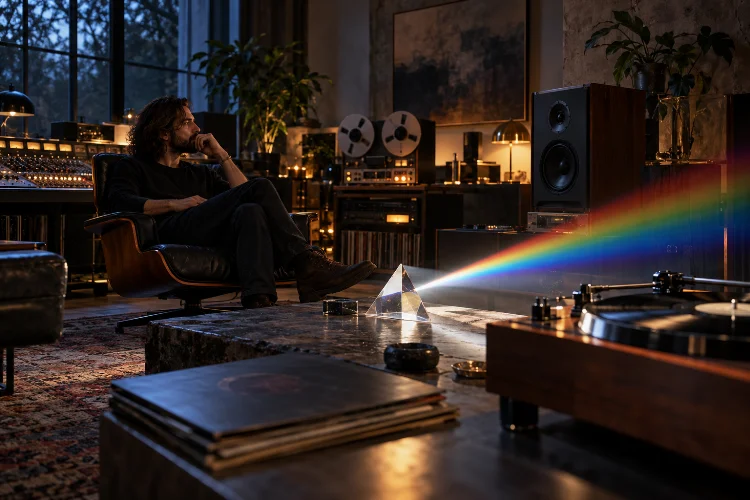
Its iconic prism artwork, created by Hipgnosis and George Hardie, became inseparable from the music’s mysterious and immersive character.
Together, the artwork, compositions, and production established a recognizable creative universe.
More than five decades after its release, The Dark Side of the Moon remains an essential example of how musical ambition and technical experimentation can support each other.
And perhaps its greatest achievement is that listeners don’t need to understand the recording process to appreciate the finished result.
They simply need to press play.
The Dark Side of the Moon redefined expectations for concept album production by combining meaningful storytelling with innovative recording techniques and carefully connected musical arrangements.
Pink Floyd transformed tape loops, synthesizers, environmental recordings, human voices, and analog mixing into essential parts of a larger artistic experience.
Working with Alan Parsons and other talented recording professionals, the band demonstrated that studio technology could expand musical expression rather than simply capture performances.
Its greatest lesson remains relevant today: unforgettable production isn’t about using the most advanced equipment. It’s about making every creative decision support the music.
Want to experience its brilliance firsthand? Listen to the entire album from beginning to end with a good pair of headphones, without skipping tracks.
Pay attention to the transitions, unusual sounds, and changing dynamics. You might discover why this 1973 masterpiece remains so influential.