
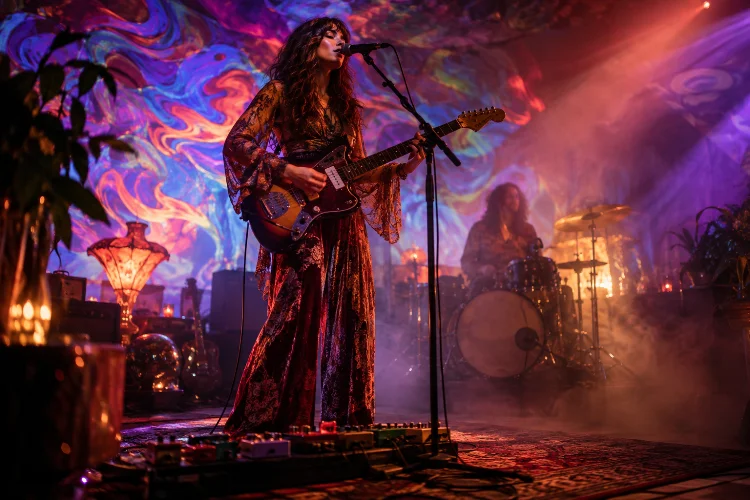
Imagine listening to a rock song where guitars sound like they’re floating through space, vocals echo from another dimension, and the rhythm suddenly shifts into something completely unexpected.
Pretty wild, right?
That’s the fascinating world of psychedelic rock.
Emerging during the cultural revolution of the 1960s, this adventurous musical style challenged almost everything people expected from traditional rock music.
Instead of sticking to predictable guitar riffs and straightforward arrangements, musicians began experimenting with unusual instruments, studio effects, extended improvisations, and dreamlike musical textures.
But the evolution of psychedelic rock didn’t stop with colorful clothes, underground concerts, and legendary bands from the 1960s.
Its experimental approach eventually influenced progressive rock, heavy metal, electronic music, alternative rock, and modern indie psychedelia.
Artists discovered that recording studios could become creative playgrounds, while electric guitars and synthesizers could produce sounds nobody had previously imagined in mainstream music.
So, how did psychedelic rock develop from an underground movement into one of music’s most influential creative traditions?
Let’s explore its origins, groundbreaking recording techniques, legendary performers, and remarkable transformation across generations.
1. The Origins of Psychedelic Rock in the 1960s
How Blues, Folk, and Experimental Music Started Everything
Before psychedelic rock became a recognizable genre, musicians were already pushing the boundaries of popular music.
During the early 1960s, British and American bands combined traditional blues, folk, rhythm and blues, and rock and roll into increasingly adventurous arrangements.
Artists began questioning whether every song needed a simple verse-chorus structure or a predictable three-minute running time.
Jazz improvisation, Indian classical music, and electronic experimentation introduced additional creative possibilities.
Groups such as the Yardbirds and the Byrds were particularly important in this transition.
Their guitar-driven recordings incorporated unusual tonal effects, extended instrumental passages, and musical ideas that moved beyond conventional pop songwriting.
The Byrds’ 1966 song “Eight Miles High” became an influential example, combining folk-rock harmonies with guitar lines inspired partly by John Coltrane’s jazz improvisation and Indian classical music.
These approaches helped establish the foundations of psychedelic guitar music.
The Counterculture Connection
The genre also developed alongside major cultural changes.
Throughout the 1960s, younger generations increasingly challenged traditional attitudes toward politics, personal freedom, art, and social expectations.
The Vietnam War, civil rights activism, and expanding countercultural communities influenced the atmosphere surrounding popular music.
Psychedelic experimentation became associated with these changes, particularly through the influence of LSD and other psychoactive substances.
However, reducing the genre entirely to drug culture would overlook its broader creative significance.
Many musicians were interested in exploring imagination, spirituality, unusual sounds, and alternative ways of organizing music.
The Texas band the 13th Floor Elevators helped popularize the term through their 1966 album The Psychedelic Sounds of the 13th Floor Elevators.
By that point, psychedelia was developing into a musical identity rather than remaining a collection of scattered experiments.
2. The Psychedelic Rock Explosion of 1966–1969
The Beatles and the Rise of Studio Experimentation
The Beatles played a major role in introducing psychedelic recording techniques to mainstream audiences.
Their 1966 album Revolver featured adventurous compositions that challenged conventional expectations about how rock records should sound.
“Tomorrow Never Knows” remains one of its most striking examples.
The song combines repetitive drumming, drone-based harmony, tape loops, and heavily processed vocals into an unusual musical landscape.
Instead of building the arrangement entirely around chord changes, the band emphasized texture, repetition, and sonic movement.
Their 1967 album Sgt. Pepper’s Lonely Hearts Club Band expanded this creative direction through elaborate arrangements, studio manipulation, and imaginative songwriting.
The album demonstrated that rock recordings could function as ambitious artistic projects rather than simply collections of potential singles.
San Francisco and the Birth of Acid Rock
Across the Atlantic, San Francisco was developing its own psychedelic identity.
Bands such as Jefferson Airplane, the Grateful Dead, and Big Brother and the Holding Company became closely associated with the city’s countercultural music scene.
Their performances often emphasized extended improvisation, collective interaction, and a freer approach to musical structure.
Jefferson Airplane’s 1967 album Surrealistic Pillow helped bring the San Francisco sound into mainstream rock culture.
Songs such as “White Rabbit” combined literary imagery, dramatic arrangements, and an unmistakable psychedelic atmosphere.
Meanwhile, the Grateful Dead developed a performance style based on spontaneous improvisation and lengthy instrumental exploration.
Their concerts could transform familiar songs into entirely different musical experiences.
The 1967 Summer of Love brought additional attention to these musicians, while events such as the Monterey International Pop Festival helped psychedelic rock reach wider audiences.
Jimi Hendrix and Pink Floyd Expanded the Sound
Jimi Hendrix approached psychedelia through the expressive possibilities of electric guitar.
His 1967 debut album, Are You Experienced, demonstrated how feedback, fuzz distortion, wah-wah effects, and creative studio production could redefine guitar-driven rock.
Tracks such as “Purple Haze” and “Third Stone from the Sun” introduced sounds that felt both aggressive and futuristic.
In Britain, Pink Floyd explored another direction.
Their debut album, The Piper at the Gates of Dawn (1967), combined Syd Barrett’s imaginative songwriting with experimental instrumental passages and unusual sound effects.
Rather than emphasizing blues-based guitar virtuosity, early Pink Floyd often focused on mysterious atmospheres and unpredictable arrangements.
Together, these artists revealed just how diverse psychedelic rock could become.
3. Experimental Recording Techniques That Defined Psychedelic Sound
Fuzz Pedals, Feedback, and Guitar Effects
One of the most recognizable characteristics of psychedelic rock is its unusual guitar tone.
Traditional rock guitar often relied on relatively direct amplification, but psychedelic musicians increasingly explored distortion, feedback, and electronic effects.
Fuzz pedals transformed ordinary guitar signals into thick, buzzing textures.
Wah-wah pedals allowed guitarists to create sweeping tonal changes that resembled shifting vowel sounds.
Feedback became another expressive technique.
Instead of automatically avoiding the high-pitched sounds produced when amplified instruments interact with loudspeakers, musicians began controlling those sounds creatively.
Jimi Hendrix became especially famous for turning feedback into a dramatic musical element.
These techniques allowed electric guitars to behave almost like electronic synthesizers, producing tones far beyond their conventional sound.
Tape Loops and Backward Recording
Long before digital audio workstations existed, producers developed imaginative ways to manipulate magnetic tape.
A tape loop involved joining a recorded section of tape into a repeating cycle.
Musicians could use these loops to create continuous rhythms, unusual background textures, or seemingly endless musical patterns.
Backward recording offered another fascinating possibility.
By reversing recorded audio, engineers could produce guitar notes and vocal sounds with unnatural attacks and unusual decays.
The Beatles used these techniques extensively during their mid-1960s experimentation.
Their work helped demonstrate that the recording studio could become an instrument in its own right.
These techniques were part of a wider history of electronic and experimental composition, but psychedelic bands introduced them to large rock audiences.
Reverb, Delay, and Phasing Effects
Space and movement became essential elements of psychedelic production.
Reverb creates the impression that a sound exists inside a particular acoustic environment, while delay produces repeating echoes.
By exaggerating these effects, producers could make vocals appear distant or guitars seem to stretch across an enormous soundstage.
Phasing and flanging introduced additional movement through the interaction of closely related audio signals.
These effects create sweeping changes in frequency, giving instruments a swirling or shifting character.
The Small Faces’ 1967 song “Itchycoo Park” became a famous example of prominent flanging effects in psychedelic pop-rock.
Modern producers can recreate similar results using digital plugins, but the original techniques required considerable technical ingenuity.
What once demanded complex analog equipment can now be achieved with a few adjustments inside recording software.
4. How Psychedelic Rock Developed Different Musical Styles
Psychedelic Pop Versus Acid Rock
As the genre expanded, different approaches began developing their own identities.
Psychedelic pop generally maintained accessible melodies and recognizable song structures while incorporating unusual production effects.
Bands could experiment with elaborate vocal harmonies, strange instruments, and imaginative lyrics without abandoning the appeal of traditional pop songwriting.
Acid rock often emphasized louder amplification, heavier distortion, and extended guitar improvisation.
The difference wasn’t always perfectly clear.
Some recordings combined both approaches, moving between catchy melodies and intense instrumental passages.
Cream’s Disraeli Gears and the Doors’ early recordings demonstrate how blues-rock, psychedelic textures, and powerful songwriting could overlap.
These differences helped establish psychedelic rock as a broad family of styles rather than one narrowly defined sound.
Indian Classical Music and New Musical Influences
Another important development involved Western rock musicians exploring Indian classical music.
The Beatles’ George Harrison became particularly interested in the sitar and studied with renowned Indian musician Ravi Shankar.
The resulting influence can be heard in recordings such as “Love You To” and “Within You Without You.”
Indian classical traditions introduced many Western listeners to musical ideas involving drones, elaborate melodic frameworks, and rhythmic cycles.
These traditions existed long before psychedelic rock, and their influence deserves recognition beyond their use as unusual studio textures.
Musicians also explored jazz improvisation, avant-garde composition, and non-Western musical traditions as sources of inspiration.
The resulting combinations could sound dramatically different from conventional rock arrangements.
This exchange wasn’t always handled with equal cultural understanding, but it expanded the range of musical influences reaching mainstream audiences.
The Global Spread of Psychedelic Music
Psychedelia wasn’t limited to Britain and the United States.
In Brazil, the Tropicália movement blended psychedelic rock with Brazilian popular music, experimental art, and cultural commentary.
Artists such as Os Mutantes, Caetano Veloso, and Gilberto Gil explored inventive arrangements that connected international rock influences with local musical traditions.
Similar experimentation developed elsewhere, including Turkey, where musicians combined psychedelic guitar sounds with Anatolian folk music.
These scenes demonstrated that psychedelic music could reflect local cultural identities rather than simply imitate American or British bands.
The result was an increasingly diverse musical landscape filled with distinctive rythmically driven arrangements, unusual instruments, and creative approaches to songwriting.
5. From Psychedelic Rock to Progressive Rock and Heavy Music
The Rise of Progressive Rock in the 1970s
By the early 1970s, the original psychedelic movement was changing.
Some bands moved toward increasingly sophisticated arrangements, longer compositions, and concept albums.
This helped shape progressive rock.
Groups such as Pink Floyd, Yes, Genesis, and King Crimson developed music that combined rock instrumentation with experimental structures and ambitious musical themes.
Pink Floyd’s The Dark Side of the Moon (1973) became a particularly influential example.
Its continuous musical flow, synthesizer textures, sound effects, and philosophical lyrics reflected ideas that had developed during the psychedelic era.
However, progressive rock generally placed greater emphasis on complex arrangements, compositional development, and technical performance.
The creative relationship between these genres was close, but they weren’t identical.
The Connection With Heavy Metal
Psychedelic experimentation also contributed to the emergence of heavier rock music.
As guitarists explored increasingly powerful amplifiers, thick distortion, and darker musical themes, the foundations of hard rock and heavy metal became more prominent.
Black Sabbath developed a particularly influential heavy sound through slow, ominous riffs and dramatic arrangements.
Although the band’s identity was distinct from psychedelic rock, its early music emerged from a broader environment of blues-based experimentation and increasingly heavy guitar tones.
Other groups combined lengthy improvisation with distorted guitars, creating music that sat between acid rock and emerging hard rock.
This helped establish the idea that experimentation could be physically intense as well as dreamy or atmospheric.
Germany’s Krautrock Revolution
Meanwhile, musicians in West Germany were pursuing a different kind of experiemental rock.
The scene commonly labeled Krautrock included artists such as Can, Neu!, Faust, and early Kraftwerk.
Rather than emphasizing traditional blues structures, many of these musicians focused on repetition, electronic sounds, and unusual production techniques.
Neu! became especially associated with the steady, forward-moving rhythmic approach often called motorik.
Can developed hypnotic compositions through improvisation and extensive tape editing.
These approaches influenced later electronic music, post-punk, alternative rock, and ambient experimentation.
Psychedelic ideas were evolving beyond swirling guitars into minimalist structures and electronic soundscapes.
6. Neo-Psychedelia and the Alternative Rock Revival
The 1980s Rediscovery of Psychedelic Music
Although psychedelic rock became less commercially dominant during the 1970s, its creative ideas never completely disappeared.
During the late 1970s and 1980s, alternative musicians began revisiting psychedelic guitar textures, dreamy melodies, and unusual production techniques.
This movement became known as neo-psychedelia.
Bands such as the Soft Boys, the Teardrop Explodes, and Echo & the Bunnymen explored different combinations of psychedelic influences and post-punk experimentation.
In California, the Paisley Underground scene revived elements of 1960s garage rock, folk-rock, and psychedelic pop.
Rather than recreating the original era exactly, these musicians blended older musical influences with contemporary attitudes.
The result introduced psychedelic sounds to audiences who hadn’t experienced the original movement.
Shoegaze, Space Rock, and the 1990s
The psychedelic tradition continued developing through increasingly atmospheric alternative rock.
Spacemen 3 became influential for their repetitive compositions, heavily distorted guitars, and minimalist approach.
Their music helped establish connections between neo-psychedelia, space rock, and emerging shoegaze.
Bands such as My Bloody Valentine and Slowdive explored dense guitar effects, layered textures, and dreamlike vocal arrangements.
Shoegaze wasn’t simply another name for psychedelic rock, but the two styles shared an interest in immersive sound.
Meanwhile, the Flaming Lips and Mercury Rev developed imaginative combinations of experimental production and melodic songwriting.
Their music demonstrated that psychedelic aesthetics could support emotionally engaging songs without relying entirely on nostalgia.
The movement had developed into something much broader than its original 1960s identity.
7. Modern Psychedelic Rock and Its Continuing Musical Influence
Tame Impala and the New Psychedelic Generation
One of the most recognizable modern psychedelic projects is Australia’s Tame Impala, led by Kevin Parker.
Its early recordings revived fuzzy guitar textures, swirling effects, and dreamy melodies associated with classic psychedelia.
The 2010 album Innerspeaker demonstrated how vintage-inspired guitar sounds could work within contemporary indie rock.
Parker later expanded the project’s musical direction.
On Currents (2015), electronic synthesizers, dance-influenced rhythms, and sophisticated studio production became increasingly prominent.
Songs such as “Let It Happen” demonstrated how psychedelic ideas could merge naturally with modern electronic pop.
Rather than repeating the musical formulas of the 1960s, Parker explored their possibilities using contemporary technology.
That ability to evolve has helped keep psychedelic music relevant to younger audiences.
King Gizzard & the Lizard Wizard and Modern Experimentation
Another important contemporary example is King Gizzard & the Lizard Wizard.
The Australian band has explored psychedelic garage rock alongside progressive rock, electronic experimentation, heavy music, and unusual tuning systems.
Their 2017 album Flying Microtonal Banana featured specially modified instruments designed to play pitches beyond conventional Western twelve-tone equal temperament.
This approach produced distinctive melodic patterns and unusual instrumental relationships.
The band’s willingness to experiment reflects the adventurous spirit of the original psychedelic movement.
Instead of treating the genre as a fixed collection of effects, they approach it as an opportunity to investigate unfamiliar musical possibilities.
Their catalog demonstrates how psychedelia can function as a creative philosophy rather than a narrowly defined genre.
How Digital Production Changed Psychedelic Music
Modern technology has dramatically expanded the possibilities available to musicians.
Digital audio workstations allow producers to manipulate recordings, create complex effects chains, and build immersive arrangements without requiring expensive professional studios.
A guitarist can combine fuzz distortion, delay, reverb, pitch shifting, and modulation to create an entirely new sonic identity.
Synthesizers and software instruments also make it possible to construct evolving textures that would have required elaborate equipment in earlier decades.
However, unlimited technological possibilities don’t automatically produce interesting music.
The most convincing psychedelic recordings usually have a clear artistic direction.
A carefully chosen delay effect can communicate more than dozens of randomly stacked plugins.
The goal is to create a particular listening experience, not simply to make everything sound unusual.
Why the Psychedelic Sound Still Matters
Perhaps the most important legacy of psychedelic rock is its encouragement of creative freedom.
It challenged the assumption that popular music needed predictable arrangements, conventional instrumentation, or clearly defined stylistic boundaries.
That influence extends into progressive rock, electronic music, alternative pop, shoegaze, and many forms of experimental production.
Its techniques also appear in modern film scores and atmospheric instrumental music.
For aspiring musicians, the approach is surprisingly accessible.
Try recording a simple guitar progression, adding a repeating delay, and gradually changing the reverb or modulation settings.
Next, experiment with reversing a short audio recording or introducing an unexpected instrumental texture.
Notice how these changes affect the emotional atmoshpere of the composition.
You don’t need vintage equipment or an expensive recording studio to explore psychedelic ideas.
Curiosity, careful listening, and a willingness to experiment remain the most important ingredients.
The evolution of psychedelic rock reveals how musical experimentation can transform entire genres.
Beginning with adventurous blues and folk-rock musicians in the 1960s, psychedelia expanded through distorted guitars, unusual recording techniques, electronic instruments, and unconventional songwriting.
Its influence helped shape progressive rock, heavy music, Krautrock, neo-psychedelia, and today’s experimental indie scene.
From the Beatles and Jimi Hendrix to Tame Impala and King Gizzard & the Lizard Wizard, each generation has discovered new ways to expand the possibilities of sound.
The genre’s greatest achievement isn’t one particular effect or instrument. It’s the idea that music should always leave room for imagination.
Want to experience that evolution yourself? Create a listening playlist featuring Revolver, Are You Experienced, The Piper at the Gates of Dawn, Innerspeaker, and Flying Microtonal Banana.
You’ll hear how psychedelic creativity continues evolving across generations.