
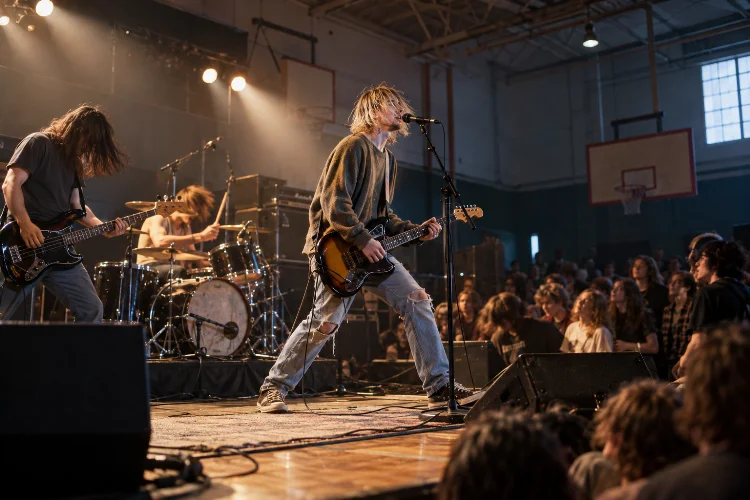
Imagine turning on MTV in 1991 and suddenly seeing something completely different from the polished rock stars dominating television.
Instead of glamorous outfits, elaborate stage productions, and perfectly styled hair, you see a chaotic high school gym filled with restless teenagers. A band dressed in everyday clothes launches into a loud, distorted guitar riff that sounds both aggressive and strangely catchy.
That band is Nirvana, and the song is “Smells Like Teen Spirit.”
When Nirvana released Nevermind on September 24, 1991, few people expected the album to become one of the most influential records in modern music history.
Yet within months, its explosive combination of punk energy, melodic songwriting, and emotional honesty had captured audiences around the world.
Understanding how Nevermind transformed alternative rock and global music culture means looking beyond its impressive commercial achievements.
The album challenged mainstream music conventions, brought underground sounds into popular culture, and influenced everything from fashion to record-label strategies.
More importantly, it gave an entire generation a different kind of musical identity.
So, how did one relatively unexpected album change the direction of rock music?
Let’s explore the sound, cultural impact, and enduring legacy behind Nirvana’s breakthrough masterpiece.
1. The Music Industry Before Nevermind Changed Everything
To understand the enormous impact of Nevermind, it helps to remember what mainstream rock looked and sounded like during the late 1980s.
Commercial radio and MTV regularly featured glamorous hard rock bands with elaborate performances, polished production, and larger-than-life personalities.
Artists such as Bon Jovi, Poison, and Mötley Crüe enjoyed substantial mainstream popularity.
Meanwhile, a completely different musical movement was developing outside the spotlight.
The Underground Alternative Rock Movement
Throughout the 1980s, independent rock bands experimented with punk influences, noisy guitars, unconventional song structures, and deeply personal lyrics.
Groups such as Sonic Youth, Pixies, Dinosaur Jr., and Hüsker Dü helped establish a musical environment where originality often mattered more than commercial expectations.
These artists developed dedicated audiences through college radio, independent labels, and extensive touring.
Their influence would become essential to Nirvana’s musical development.
Seattle and the wider Pacific Northwest also developed a thriving underground rock scene.
Bands such as Soundgarden, Mudhoney, and Green River helped establish the heavy, distorted musical approach later associated with grunge.
Nirvana emerged from this environment rather than creating it from scratch.
Nirvana’s Journey From Bleach to Nevermind
Nirvana formed in Aberdeen, Washington, with Kurt Cobain on guitar and vocals and Krist Novoselic on bass.
Their debut album, Bleach, arrived in 1989 through the independent label Sub Pop.
The recording featured a raw combination of punk rock, heavy guitar riffs, and alternative influences.
Although it attracted attention within underground music circles, the album initially reached a relatively limited audience.
The band’s situation changed significantly after Dave Grohl joined as drummer in 1990.
His powerful playing gave Nirvana a stronger rhythmic foundation.
With a new lineup and a recording contract with DGC Records, the band began preparing the album that would dramatically expand its audience.
2. Smells Like Teen Spirit and the Explosion of Grunge Music
Every musical revolution seems to have a defining moment.
For Nirvana, that moment arrived with “Smells Like Teen Spirit.”
Released as the lead single from Nevermind, the song became an unexpected cultural phenomenon.
A Guitar Riff That Captured a Generation
The opening guitar riff is remarkably simple.
Built around a repeating four-chord pattern, it immediately establishes a memorable musical identity.
However, the arrangement’s real power comes from its dramatic contrast.
Quiet, restrained verses suddenly explode into loud choruses filled with distorted guitars and forceful drumming.
This quiet-loud dynamic was influenced partly by bands such as Pixies, whose music Cobain admired.
The technique wasn’t entirely new, but Nirvana used it with extraordinary effectiveness.
Listeners could enjoy the song’s melodic hooks while experiencing the intensity of punk-inspired rock.
That combination helped make an underground musical approach accessible to a much wider audience.
How MTV Turned Nirvana Into Global Stars
The accompanying music video played a crucial role in the song’s success.
Directed by Samuel Bayer, it featured Nirvana performing inside a gloomy school gym while cheerleaders and students gradually descended into chaos.
The imagery felt noticeably different from many heavily stylized rock videos of the period.
Instead of portraying musicians as glamorous celebrities, the video presented frustration, boredom, rebellion, and youthful energy.
MTV placed the video into heavy rotation during late 1991.
As its popularity increased, audiences outside traditional alternative rock circles discovered Nirvana.
The song eventually reached number six on the Billboard Hot 100.
For a band emerging from the independent music scene, that achievement represented an extraordinary breakthrough.
Grunge Becomes a Mainstream Phenomenon
Almost overnight, the word “grunge” became familiar to mainstream music audiences.
Record companies, journalists, and television networks began paying closer attention to Seattle’s underground music community.
However, Nirvana’s success did not mean every alternative band suddenly sounded alike.
Groups such as Pearl Jam, Alice in Chains, and Soundgarden already had distinct musical identities.
What changed was the industry’s willingness to promote heavier, less polished music to mass audiences.
Nevermind helped open a commercial door that many alternative artists had previously struggled to enter.
3. The Recording Innovations Behind Nevermind’s Powerful Sound
One of the most fascinating things about Nevermind is how it balances raw energy with surprisingly accessible production.
The album sounds aggressive, but its instruments and melodies remain clear.
That balance was essential to its crossover success.
Recording at Sound City Studios
Nirvana recorded most of the album in May 1991 at Sound City Studios in Van Nuys, California.
Producer Butch Vig worked closely with Cobain, Novoselic, and Grohl to capture their energetic performances.
Sound City was known for its distinctive recording environment and powerful drum sounds.
Grohl’s drumming became one of the defining elements of the sessions.
His combination of precision, physical intensity, and simple but memorable rhythmic patterns gave the songs enormous momentum.
The sessions were relatively efficient because the band had rehearsed much of the material extensively.
According to Vig, the main recording process took approximately 16 days.
Balancing Distortion With Melodic Clarity
A major achievement of the production was preserving Nirvana’s abrasive guitar textures without sacrificing songwriting clarity.
Cobain frequently used distorted electric guitars, but his chord progressions remained direct and memorable.
Vig also encouraged techniques such as guitar overdubbing and vocal double-tracking.
These processes helped certain sections sound fuller and more powerful.
Mixing engineer Andy Wallace later contributed to the album’s finished sonic character.
His mixes emphasized clarity and impact, making the songs suitable for a wider range of playback systems and radio formats.
Interestingly, Cobain later expressed reservations about how polished the finished record sounded.
That tension highlights an important part of the album’s story.
Its commercial breakthrough depended partly on making underground rock accessible without completely removing its intensity.
Why the Production Still Matters
Modern musicians can learn a valuable lesson from this approach.
Heavy music doesn’t necessarily require complicated instrumental arrangements.
Sometimes, a simple guitar riff becomes incredibly powerful when supported by effective drumming, strong melodies, and carefully controlled dynamics.
The production also demonstrates how contrasting textures can improve emotional impact.
A quiet section makes the following distorted chorus feel considerably more explosive.
That principle remains widely used in contemporary rock production.
4. Kurt Cobain’s Songwriting and the Emotional Power of Nevermind
Beyond its innovative sound, Nevermind became influential because its songs connected with listeners emotionally.
Kurt Cobain’s writing often combined memorable melodies with ambiguous, fragmented, and deeply personal lyrics.
Rather than presenting straightforward stories, he created songs that invited listeners to form their own interpretations.
Emotional Honesty Without Conventional Rock Heroics
Many mainstream rock songs of the previous decade emphasized confidence, romance, partying, and glamorous lifestyles.
Nirvana frequently explored very different emotions.
Alienation, confusion, frustration, vulnerability, and discomfort appeared throughout Cobain’s writing.
Songs such as “Lithium” and “Drain You” combine unusual lyrical imagery with energetic arrangements.
Their emotional intensity feels genuine, even when the meanings remain difficult to define.
Cobain’s vocal style contributed significantly to this effect.
He could shift from relatively restrained singing to explosive screaming within the same composition.
This contrast made his performances sound immediate and emotionally unpredictable.
The Different Personalities of Nevermind’s Songs
Although “Smells Like Teen Spirit” became the album’s biggest cultural breakthrough, the remaining tracks reveal considerable musical variety.
“Come as You Are” features a distinctive, chorus-effect guitar riff and a hypnotic atmosphere.
“In Bloom” combines heavy instrumentation with an unusually catchy vocal melody.
“Lithium” moves between gentle verses and powerful choruses, creating a memorable emotional progression.
Meanwhile, “Polly” uses a stripped-down acoustic arrangement to address disturbing subject matter connected to violence against women.
The song demonstrates that Nirvana could communicate uncomfortable ideas without relying on overwhelming instrumental volume.
“Something in the Way” closes the main album sequence with an intimate, subdued performance.
Its quiet atmosphere provides a striking contrast to the explosive opening.
Together, these tracks create a record with remarkable emotional range.
Why Imperfection Became Part of the Appeal
Cobain’s performances didn’t always follow conventional expectations of technical perfection.
His vocals could sound strained, his guitar playing could feel rough, and his arrangements frequently embraced noisy textures.
Yet these characteristics contributed to the music’s identity.
Listeners connected with the feeling that a real person was expressing something difficult to communicate.
For many aspiring musicians, this was incredibly encouraging.
You didn’t necessarily need exceptional technical virtuosity to create meaningful music.
You needed compelling ideas, emotional commitment, and the courage to express them.
That philosophy became one of alternative rock’s most influential creative principles.
5. How Nevermind Influenced Fashion, Youth Identity, and Pop Culture
The impact of Nirvana’s breakthrough extended far beyond music.
During the early 1990s, alternative rock increasingly influenced youth fashion, television, film, and cultural attitudes.
The band’s appearance offered a dramatically different model of what a successful rock musician could look like.
From Glamorous Rock Stars to Everyday Clothing
Kurt Cobain frequently appeared wearing ordinary clothes, including cardigans, loose sweaters, worn jeans, and flannel shirts.
His style contrasted sharply with the elaborate fashion associated with many mainstream rock performers.
As grunge grew in popularity, similar clothing became increasingly visible in youth culture.
Flannel shirts, oversized knitwear, distressed denim, and practical footwear gained new cultural associations.
Interestingly, these clothes had already existed within working-class and underground communities.
The music industry’s attention transformed them into widely recognized fashion symbols.
By the early 1990s, major fashion designers were experimenting with grunge-inspired collections.
The transition demonstrated how subcultural aesthetics could become commercial trends.
Generation X Finds a Musical Identity
The album’s emotional atmosphere strongly resonated with many younger listeners.
Its songs expressed uncertainty, cynicism, vulnerability, and frustration without offering simplistic solutions.
For audiences who felt disconnected from established expectations, Nirvana’s music offered a recognizable emotional language.
Cobain became closely associated with Generation X, although the diversity of that generation makes any single musical spokesperson an imperfect label.
He also appeared uncomfortable with many aspects of celebrity culture.
That contradiction made his public image especially compelling.
A musician who seemed resistant to mainstream fame had become one of its most recognizable figures.
The situation was suprisingly complicated for an artist whose music emerged from independent rock culture.
The Cultural Meaning of the Album Cover
The artwork also became one of the most recognizable images in modern music history.
Photographed by Kirk Weddle, the cover depicts an infant swimming underwater toward a dollar bill attached to a fishing hook.
The image has often been interpreted as a commentary on materialism and the pursuit of money.
Its combination of innocence and commercial symbolism suited the album’s broader cultural atmosphere.
However, the photograph has also attracted controversy concerning consent and the depiction of the child.
Whatever interpretation listeners prefer, the artwork became inseparable from the record’s visual identity.
It demonstrated how album packaging could communicate a provocative artistic idea before listeners heard a single note.
6. The Music Industry Revolution Sparked by Nevermind
Perhaps the clearest evidence of the album’s commercial impact appeared in January 1992.
On January 11, Nevermind reached number one on the Billboard 200.
It displaced Michael Jackson’s Dangerous from the top position, creating a symbolic moment in popular music history.
Alternative rock had become a major commercial force.
A Commercial Breakthrough Nobody Fully Expected
Nirvana’s second album ultimately sold millions of copies around the world.
By the late 1990s, it had achieved Diamond certification in the United States, representing more than 10 million certified units.
Worldwide sales have commonly been reported at more than 30 million copies.
These figures were extraordinary for a band originating from an underground music environment.
Its success challenged assumptions about which types of artists could generate major record sales.
The album also helped demonstrate that audiences were interested in music outside established mainstream formulas.
Record Labels Rush Toward Alternative Rock
Following Nirvana’s breakthrough, major record companies increased their attention to alternative guitar bands.
Artists associated with grunge, indie rock, and other underground movements attracted greater commercial interest.
Record labels became more willing to invest in unconventional sounds and less glamorous artist images.
Bands including Soundgarden, Alice in Chains, and Pearl Jam achieved substantial success during this period.
Other alternative acts also benefited from the expanding audience for guitar-driven music.
However, the relationship between artistic independence and commercial popularity became increasingly complicated.
Some musicians welcomed greater exposure, while others worried that corporate involvement would weaken underground music’s identity.
The Contradiction of Commercialized Rebellion
One of the most interesting consequences of Nevermind was the commercialization of an anti-establishment aesthetic.
Music originally associated with independent labels and underground venues suddenly became an attractive commercial product.
Fashion companies marketed grunge clothing, and record labels searched for musicians who could reproduce Nirvana’s success.
The industry sometimes treated an entire collection of distinct musical communities as one easily recognizable trend.
This process created opportunities for artists but also encouraged imitation.
It was an intresting contradiction: music that challenged commercial expectations became one of the most valuable commercial discoveries of the decade.
The story illustrates how cultural movements can change when they attract mass audiences.
7. Nevermind’s Lasting Legacy in Global Alternative Music
More than three decades after its release, Nevermind remains an essential reference point for musicians exploring alternative rock.
Its influence can be heard in post-grunge, punk-influenced rock, emo, indie rock, and numerous other styles.
However, its greatest contribution may be broader than any particular genre.
Inspiring New Generations of Musicians
Nirvana demonstrated that emotionally direct songwriting could connect with millions of people.
The band combined punk-inspired energy with pop melodies, creating a musical formula that countless later artists would explore.
Post-grunge bands adopted elements of its distorted guitar sound and dynamic song structures.
Alternative musicians also drew inspiration from Cobain’s vulnerable vocal delivery and unconventional lyrical approach.
Not every artist influenced by Nirvana tried to reproduce its exact sound.
For some, the more important lesson was that an independant musical identity could resonate beyond its original audience.
The album encouraged young musicians to experiment without assuming that mainstream approval should determine their creative direction.
Alternative Rock Becomes a Global Language
Although Seattle played a central role in the grunge movement, the album’s influence extended far beyond the United States.
Its international popularity helped introduce audiences around the world to American underground guitar music.
New listeners began exploring earlier alternative bands, independent labels, and regional rock scenes.
Local musicians incorporated distorted guitar textures, emotionally expressive vocals, and contrasting song dynamics into their own styles.
These adaptations didn’t always resemble traditional Seattle grunge.
Instead, they demonstrated how musical ideas could travel between different cultural environments.
The album’s influence contributed to a broader international conversation about authenticity, creativity, and artistic independence.
Why Modern Listeners Still Connect With the Album
Trends in popular music have changed dramatically since 1991.
Streaming platforms, social media, and digital production have transformed how artists create and distribute music.
Yet the emotional qualities that made Nirvana compelling remain relatable.
Feelings of uncertainty, alienation, frustration, and the desire for belonging are hardly limited to one generation.
That helps explain why younger listeners continue discovering these recordings.
The Rock & Roll Hall of Fame recognized Nirvana’s historical significance by inducting the band in 2014.
Their influence continues through recordings, documentaries, tribute performances, and educational material.
What Today’s Artists Can Learn From Nirvana
Modern musicians don’t need to copy Cobain’s guitar tone or vocal style to understand his creative approach.
Start by focusing on songwriting.
A simple chord progression can become memorable through strong melodies, effective arrangements, and emotional delivery.
Next, experiment with dynamics.
Try recording a quiet verse followed by a powerful chorus and notice how the contrast changes the song’s impact.
Avoid assuming that polished production automatically creates better music.
Sometimes, leaving small imperfections in a performance makes it feel more human and expressive.
Finally, develop your own musical identity instead of following every popular trend.
The most important lesson from Nirvana’s success is that original ideas can reach enormous audiences when they connect with genuine human experiences.
Their influence survives becuase the music communicates something deeper than a temporary fashion.
Nevermind transformed alternative rock by bringing underground musical ideas into mainstream culture without completely abandoning their emotional intensity.
Its powerful guitar riffs, unforgettable melodies, innovative production, and vulnerable songwriting changed what audiences expected from commercially successful rock music.
Beyond the recording studio, the album influenced MTV, youth fashion, record-label strategies, and the global popularity of alternative music.
Perhaps its greatest achievement was proving that unconventional artists could connect with massive audiences while maintaining a recognizable creative identity.
More than three decades later, its cultural impact remains impossible to ignore.
Want to understand why this album became legendary? Listen to Nevermind from beginning to end, explore Nirvana’s earlier recordings, and discover the alternative bands that helped shape its sound.
You might find that its musical revolution still feels remarkably relevant.