
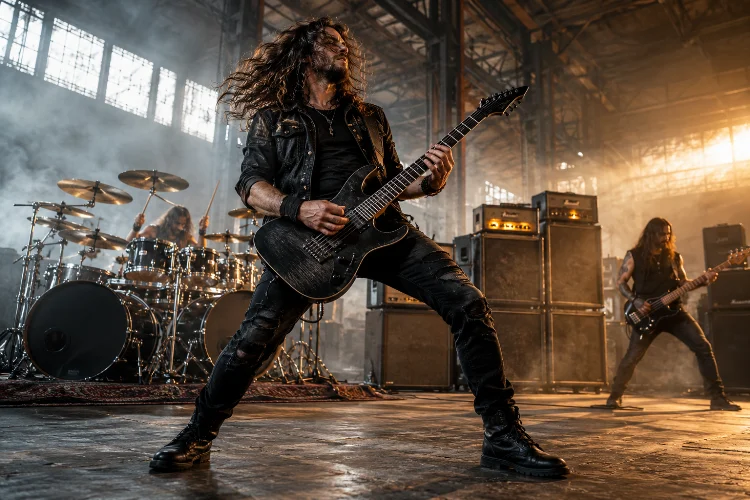
Ever wondered how the blues-inspired guitar riffs of the 1960s eventually transformed into the thunderous, aggressive, and technically complex sounds of modern heavy metal?
It’s a pretty fascinating musical journey.
Back when bands like Led Zeppelin and Deep Purple were experimenting with louder amplifiers and distorted guitars, few people could have predicted just how extreme rock music would eventually become.
Fast-forward several decades, and heavy metal has developed into a massive musical universe filled with thrash metal, death metal, progressive metal, metalcore, and countless other styles.
But this transformation didn’t happen overnight.
The evolution of hard rock into modern heavy metal involved generations of musicians pushing boundaries, developing new guitar techniques, experimenting with technology, and challenging traditional songwriting conventions.
From Black Sabbath’s dark, haunting riffs to Metallica’s lightning-fast rhythms and the crushing breakdowns of contemporary metalcore, every generation added something different.
Understanding this musical evolution also reveals how technology, cultural movements, and creative experimentation helped shape one of the world’s most recognizable music genres.
Let’s explore how hard rock gradually developed into the diverse and powerful world of modern heavy metal.
1. The Birth of Hard Rock in the Late 1960s
Blues Rock Became Louder and More Aggressive
Heavy metal didn’t suddenly appear out of nowhere.
Its foundations developed during the late 1960s when musicians began transforming traditional blues and rock ‘n’ roll into something louder, heavier, and more intense.
Artists such as Jimi Hendrix, Cream, and the Jeff Beck Group experimented with distorted electric guitars, powerful amplifiers, and extended instrumental performances.
These musicians demonstrated that electric guitar distortion could become a creative musical feature rather than an unwanted technical problem.
Meanwhile, bands were beginning to place greater emphasis on memorable guitar riffs.
Instead of treating the guitar as simple accompaniment, musicians started building entire songs around powerful instrumental phrases.
This shift became essential to the development of heavy music.
Led Zeppelin and Deep Purple Established the Hard Rock Blueprint
Led Zeppelin and Deep Purple were particularly important during this transitional period.
Led Zeppelin combined blues traditions with folk influences, aggressive guitar riffs, and dynamic arrangements.
Jimmy Page’s playing on songs such as “Whole Lotta Love” and “Immigrant Song” demonstrated how distortion, rhythmic repetition, and dramatic performances could create enormous musical energy.
Deep Purple approached heaviness through a combination of blues-rock, classical influences, and instrumental virtuosity.
Their 1970 album Deep Purple in Rock showcased powerful vocals, intense guitar work, and driving rhythms that anticipated many characteristics of traditional heavy metal.
“Speed King” and “Child in Time” remain excellent examples of this emerging direction.
However, hard rock still maintained a strong connection to blues-based songwriting.
The next major development would push the genre toward darker musical territory.
2. Black Sabbath Created the Foundation of Heavy Metal
Dark Guitar Riffs Changed Everything
If one band deserves particular recognition for establishing heavy metal’s early identity, it’s Black Sabbath.
Formed in Birmingham, England, the group developed a sound that was noticeably darker than the hard rock performed by many of its contemporaries.
Their self-titled debut album, released in February 1970, introduced listeners to ominous guitar riffs, unsettling atmospheres, and lyrical themes inspired by fear, war, and supernatural imagery.
The opening track, “Black Sabbath,” remains especially influential.
Its main guitar riff prominently uses a tritone, a dissonant musical interval that creates an unstable, threatening feeling.
Combined with thunderstorm effects and Ozzy Osbourne’s haunting vocals, the composition sounded radically different from conventional blues-rock.
Songs such as “Paranoid,” “Iron Man,” and “War Pigs” further developed the band’s powerful musical identity.
Tony Iommi’s Guitar Innovations
Guitarist Tony Iommi played an essential role in establishing the heavy metal guitar sound.
After a factory accident damaged the tips of two fingers on his fretting hand, he developed techniques that made guitar playing more manageable.
These included using modified fingertip coverings and lighter strings.
He later experimented with lower guitar tunings, which reduced string tension while producing a darker, thicker sound.
This approach became especially prominent on Master of Reality in 1971.
Songs such as “Into the Void” and “Children of the Grave” demonstrated how low tuning could create a heavier musical atmosphere.
Interestingly, Black Sabbath’s first two albums were largely recorded in standard tuning, meaning their heaviness initially came from songwriting, tone, and performance rather than detuning alone.
That distinction is important because modern heavy metal isn’t simply about playing lower notes.
It’s about creating tension, intensity, and emotional weight through musical choices.
3. Judas Priest and the New Wave of British Heavy Metal
Judas Priest Defined a More Focused Metal Sound
During the 1970s, heavy metal gradually developed a clearer identity.
Judas Priest played a central role in this transformation.
While Black Sabbath emphasized dark atmospheres and relatively slow, crushing riffs, Judas Priest increasingly embraced faster tempos, precise guitar arrangements, and soaring vocals.
Guitarists Glenn Tipton and K.K. Downing developed a powerful twin-guitar approach that became enormously influential.
Their harmonized leads, aggressive rhythmic playing, and memorable solos helped establish a recognizable metal vocabulary.
Rob Halford’s extraordinary vocal range added another distinctive element.
Albums such as British Steel and Screaming for Vengeance demonstrated how traditional heavy metal could combine intensity with accessible songwriting.
The band also popularized a leather-and-studs visual identity that became closely associated with metal culture.
The New Wave of British Heavy Metal Accelerated Everything
By the late 1970s, another musical movement was emerging in Britain.
Known as the New Wave of British Heavy Metal, or NWOBHM, it combined the established power of heavy rock with the urgency and energy associated with punk.
Bands such as Iron Maiden, Saxon, and Diamond Head helped make heavy music faster and more rhythmically intense.
Iron Maiden became particularly influential through galloping bass lines, harmonized guitars, and elaborate songwriting.
Their 1982 album The Number of the Beast helped introduce this energetic style to a much larger international audience.
Songs such as “Run to the Hills” demonstrated how speed and melody could exist together.
Meanwhile, Diamond Head’s powerful riffs influenced the American musicians who would soon create thrash metal.
This movement helped establish the technical and stylistic foundations of several later subgenres.
4. Thrash Metal Transformed Speed and Aggression
Metallica and the Rise of Thrash Metal
By the early 1980s, some musicians wanted heavy metal to become even faster and more aggressive.
They began combining traditional metal riffs with the intensity of hardcore punk.
The result was thrash metal.
Metallica, Slayer, Megadeth, and Anthrax became the movement’s most recognizable representatives, collectively known as the Big Four.
Metallica’s debut album, Kill ‘Em All, released in 1983, featured rapid guitar riffs, aggressive vocals, and relentless rhythmic energy.
Songs such as “Whiplash” and “Seek & Destroy” demonstrated how far the musical style had evolved from its blues-rock origins.
Rather than relying on a swinging blues groove, thrash emphasized tight rhythmic precision.
Fast alternate picking, palm-muted guitar passages, and forceful drumming became essential characteristics.
Technical Complexity Became Increasingly Important
Thrash wasn’t simply about performing songs as quickly as possible.
As the genre matured, musicians developed increasingly sophisticated arrangements.
Metallica’s Master of Puppets, released in 1986, combined aggressive riffs with complex song structures and dramatic changes in intensity.
Megadeth emphasized intricate guitar patterns, challenging rhythmic transitions, and technically demanding solos.
Slayer took a more relentless approach, particularly on Reign in Blood, which became a landmark of extreme metal.
Anthrax incorporated hardcore influences and a distinctive sense of rhythmic energy.
These bands helped establish a new expectation for instrumental skill.
Metal guitarists increasingly focused on precise picking, synchronized rhythms, and demanding arrangements.
Thrash also demonstrated that heavy music could address political conflict, social problems, war, and psychological subjects without abandoning its agressive identity.
5. Death Metal, Black Metal, and the Expansion of Extreme Music
Death Metal Pushed the Boundaries of Heaviness
During the mid-to-late 1980s, some musicians began exploring sounds that were even more extreme than thrash.
Death metal emerged through an underground network of bands, independent labels, and dedicated fans.
Groups such as Death, Morbid Angel, and Obituary helped establish its early identity.
The genre emphasized heavily distorted guitars, rapid drumming, aggressive vocal techniques, and complicated musical arrangements.
Growled vocals became one of its most recognizable characteristics.
Rather than emphasizing traditional melodic singing, performers used harsh vocal textures to complement the music’s intensity.
Drummers increasingly incorporated blast beats, rapid double-bass patterns, and sudden rhythmic changes.
Death metal also developed multiple stylistic directions.
Technical death metal emphasized instrumental complexity, while melodic death metal incorporated harmonized guitar melodies and more accessible musical structures.
Black Metal Created an Entirely Different Atmosphere
Black metal developed along a related but distinct path.
Early groups such as Venom and Bathory contributed to its formation, while the Norwegian scene of the early 1990s helped establish many of its recognizable characteristics.
Bands such as Mayhem, Darkthrone, and Emperor explored raw production, tremolo-picked guitar riffs, harsh vocals, and dark atmospheric arrangements.
Unlike some forms of death metal, black metal frequently prioritized mood over technical perfection.
Its recordings sometimes deliberately featured rough, low-fidelity production.
This approach created a cold, distant musical atmosphere that became part of the genre’s identity.
Meanwhile, doom metal developed in another direction by embracing extremely slow tempos and enormous guitar sounds.
These contrasting developments proved that heavyness didn’t always require greater speed.
Sometimes, playing slower could make the music feel even more overwhelming.
6. The 1990s Introduced Groove Metal and Nu Metal
Pantera Changed the Rhythm of Heavy Music
After years of increasingly fast guitar playing, some metal musicians began concentrating on groove.
Pantera became especially influential through albums such as Cowboys from Hell in 1990 and Vulgar Display of Power in 1992.
Guitarist Dimebag Darrell combined crushing riffs with expressive guitar solos and a distinctive distorted tone.
Rather than maintaining constant high-speed intensity, the band’s music often relied on syncopated rhythms and powerful pauses.
Songs such as “Walk” demonstrated how a comparatively simple riff could sound enormous when combined with precise drumming and aggressive production.
This groove-oriented approach influenced numerous bands during the 1990s and beyond.
It also demonstrated that rhythmic impact could be just as important as technical speed.
Korn, Slipknot, and the Nu Metal Revolution
Another major development appeared during the 1990s with the rise of nu metal.
Bands such as Korn introduced a mixture of heavy guitar riffs, hip-hop-inspired rhythms, alternative rock influences, and highly personal lyrics.
Korn’s self-titled debut album, released in 1994, helped establish the genre’s musical direction.
Their use of seven-string guitars contributed to a distinctive low-frequency sound.
Other bands expanded the formula.
Limp Bizkit incorporated rap vocals and funk-influenced grooves, while Slipknot developed a more extreme combination of percussion, aggressive guitar work, and intense performances.
Linkin Park later brought melodic vocals, electronic production, and hip-hop elements into a highly accessible crossover sound.
Nu metal attracted listeners who weren’t necessarily interested in traditional heavy metal.
It demonstrated that the genre could absorb contemporary musical influences without completely abandoning its distorted-guitar foundations.
7. Metalcore and Progressive Metal Redefined Modern Heavy Music
Metalcore Combined Hardcore and Metal Traditions
During the late 1990s and early 2000s, metalcore became an increasingly important part of heavy music.
The genre developed from earlier combinations of hardcore punk and metal, eventually incorporating melodic death metal influences and more polished production.
Bands such as Killswitch Engage, Unearth, and Shadows Fall played significant roles in popularizing this newer melodic approach.
Their music combined heavy guitar riffs, breakdowns, screaming vocals, and memorable melodic choruses.
Killswitch Engage’s The End of Heartache, released in 2004, became a particularly influential example.
The album demonstrated how aggressive verses could contrast with emotionally powerful clean singing.
This structure became widely recognizable throughout modern metalcore.
Meanwhile, bands such as Architects and Bring Me the Horizon continued developing the style through atmospheric textures, electronic elements, and increasingly adventurous arrangements.
Breakdowns Became a Defining Musical Technique
One of metalcore’s most recognizable features is the breakdown.
A breakdown typically emphasizes slower or more spacious rhythmic patterns, frequently using low guitar notes and synchronized drum accents.
The objective is to create an especially powerful physical impact.
Unlike traditional guitar solos, breakdowns focus primarily on rhythmic intensity.
They often feature palm-muted riffs, pauses, and tightly coordinated instrumental attacks.
For guitarists, this requires precise timing rather than simply maximum picking speed.
A basic breakdown can sound surprisingly powerful when every instrument emphasizes the same rhythmic pattern.
Progressive Metal and the Rise of Djent
Progressive metal developed another approach to musical heaviness.
Bands such as Dream Theater combined advanced instrumental techniques with complex compositions influenced by progressive rock.
Later, Meshuggah became particularly influential through low-tuned guitars, unconventional rhythmic patterns, and an extremely precise playing style.
Their work helped inspire the djent movement.
Djent is associated with tightly controlled guitar distortion, extended-range instruments, and rhythmically complex riffs.
Bands such as Periphery and Tesseract developed these ideas further, incorporating atmospheric passages, sophisticated production, and melodic vocals.
The result demonstrates how modern heavy metal can combine technical complexity with emotional songwriting.
Today, a single composition might include crushing guitar riffs, delicate ambient sections, electronic textures, and intricate rhythmic patterns.
That musical flexibility is one of the genre’s most interesting developments.
8. How Technology Changed Heavy Metal Guitar Sounds and Production
Lower Tunings and Extended-Range Guitars
One of the most noticeable changes in modern heavy music involves guitar tuning.
Traditional hard rock frequently used standard tuning, while later metal bands increasingly experimented with lower pitches.
Drop D, Drop C, and other alternative tunings became common in various subgenres.
Seven-string and eight-string guitars introduced even greater low-frequency possibilities.
However, lower tunings also create technical challenges.
Musicians must carefully select string gauges, adjust instrument setup, and control unwanted resonance.
Modern metal guitarists frequently use precise palm muting and carefully controlled distortion to maintain clarity.
A heavily distorted guitar doesn’t automatically sound more powerful when additional gain is applied.
In fact, excessive distortion can reduce note definition and make complicated riffs difficult to understand.
Digital Recording and Modern Metal Production
Recording technology has also transformed the genre.
Early hard rock bands relied on analog tape machines, traditional amplifiers, and relatively limited recording tracks.
Modern producers can access advanced digital audio workstations, virtual amplifiers, sophisticated editing tools, and powerful audio-processing software.
These technologies allow musicians to build professional-sounding productions without requiring enormous recording budgets.
Guitar amplifier modeling makes it possible to explore different tonal characteristics using software.
Meanwhile, modern drum recording may combine real performances with carefully selected samples.
Digital editing can improve timing and consistency, although excessive correction sometimes removes the natural energy of a performance.
For contemporary metal producers, the challenge is balancing technical precision with musical personality.
The most effective recordings preserve the intensity of human performance while taking advantage of modern production capabilities.
Why Heavy Metal Continues to Evolve
What makes heavy metal particularly fascinating is its ability to continually reinvent itself.
Every generation has introduced new influences, equipment, techniques, and cultural perspectives.
Modern bands frequently combine elements of progressive metal, metalcore, electronic music, and alternative rock.
Artists such as Spiritbox demonstrate how atmospheric sound design and aggressive guitar work can coexist with melodic songwriting.
Meanwhile, groups including Gojira continue exploring rhythmic intensity, unusual guitar techniques, and environmentally conscious themes.
The boundaries between subgenres have become increasingly flexible.
For listeners, this means heavy music offers more variety than ever before.
For musicians, it creates exciting opportunities for creative experementation.
You don’t have to follow every convention established by earlier generations.
Instead, you can study the traditions, identify the sounds that inspire you, and develop something original.
The transformation of hard rock into modern heavy metal is a remarkable story of creativity, experimentation, and musical evolution.
What began with blues-inspired guitar riffs gradually developed into the dark atmosphere of Black Sabbath, the precision of Judas Priest, and the speed of thrash metal.
Later generations introduced extreme vocals, alternative tunings, complex rhythms, electronic production, and entirely new approaches to songwriting.
Today, heavy metal represents a diverse family of musical styles rather than one narrowly defined sound.
Yet its central spirit remains remarkably consistent: challenging expectations and pushing musical boundaries.
If you’re passionate about heavy music, revisit the classic recordings that started it all. Compare their riffs, rhythms, and production techniques with those of modern bands.
You might discover that the future of heavy metal is still closely connected to its rebellious beginnings.